
It continues the story by explaining why the cool, watery earth we built in article 2 doesn’t stay still.
Article Overview
In this chapter, we will discover:
- The Giant Puzzle: How the continents fit together like pieces of a jigsaw puzzle.
- Floating Rocks: Why the ground you stand on is actually moving.
- Volcanoes: How mountains spit fire when rocks crash together.
- Earthquakes: Why the ground shakes when rocks get stuck.
- The Recycling Machine: Why Earth needs volcanoes to stay alive.
Introduction: Look out your window. The ground looks solid, doesn’t it? It doesn’t move. It feels safe. But this is an illusion. The Earth beneath your feet is actually a restless giant that never sleeps. It is constantly moving, stretching, and crashing. Let’s find out why.
Table of Contents
3.1 The World is a Jigsaw Puzzle
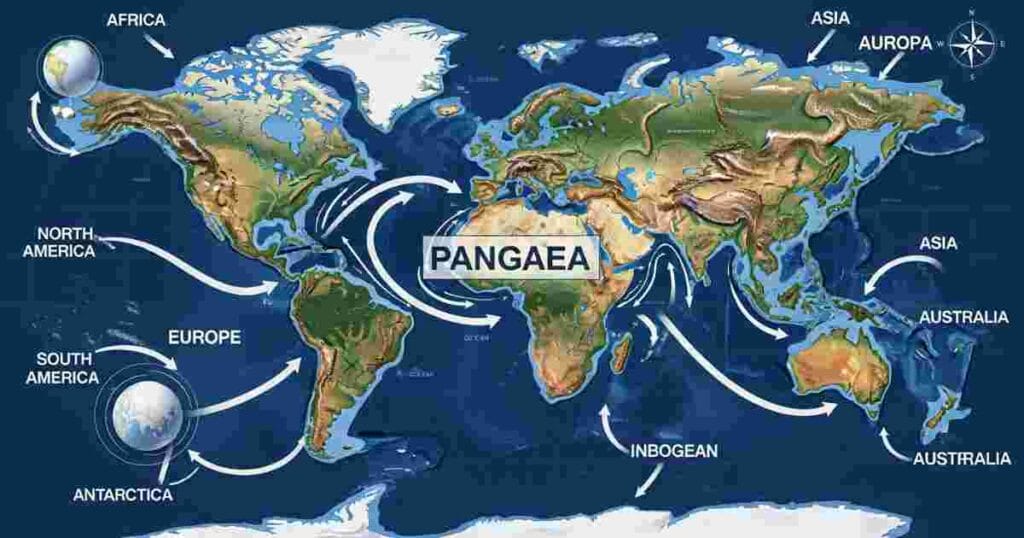
Look at a map of the world. Look at South America and Africa.
Do you notice something strange?
If you cut them out with scissors, they fit together almost perfectly.
For a long time, people thought this was just an accident.
Then, a scientist named Alfred Wegener had a crazy idea: He said that millions of years ago, all the continents were stuck together in one super-giant land called Pangaea.
He said the continents broke apart and slowly drifted away from each other.
Everyone thought he was wrong. But he was right.
3.2 Why the Ground Moves (Plate Tectonics)
How can a whole continent like Africa move? It’s too heavy!
Remember in Chapter 1 we learned Earth is like an egg?
- The Crust (where we live) is the thin shell.
- The Mantle underneath is hot, gooey rock.1
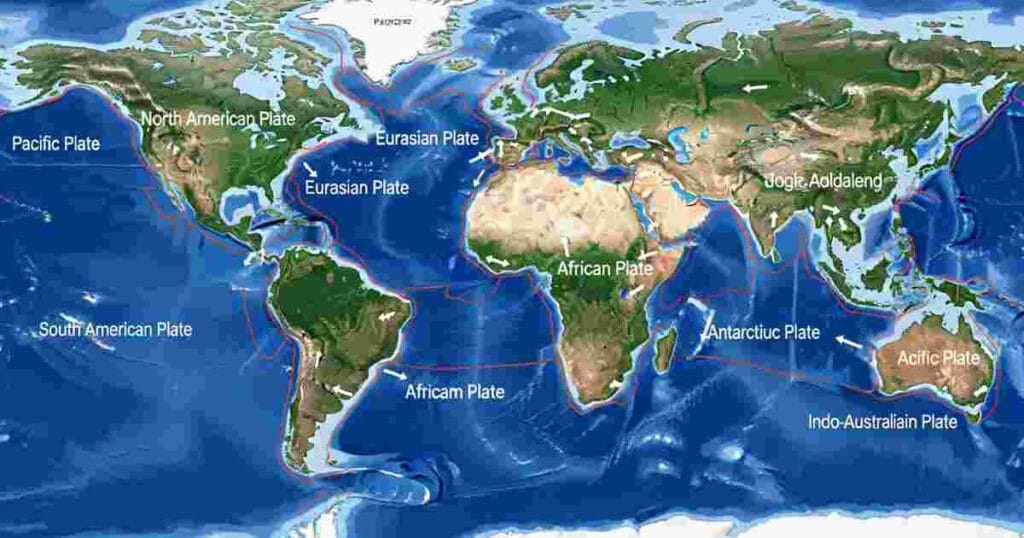
The great secret of geology is this: The Earth’s crust is not one solid piece. It is broken into giant pieces called Tectonic Plates.2 Think of a cracked eggshell.
There are about seven big plates and many small ones.
The “Cracker and Soup” Analogy:
Imagine a bowl of hot tomato soup. The soup is moving because it’s hot.
Now, break up some crackers and drop them on top.
The crackers will float and move around because the soup underneath is moving.
- The Crackers are the Tectonic Plates (continents).
- The Hot Soup is the Mantle.
Because the Mantle is hot and swirling, the plates on top ride along like rafts. They move very slowly—about as fast as your fingernails grow.
3.3 The Crash: Volcanoes and Mountains
These giant plates are constantly crashing into each other. What happens when they crash?
Scenario A: The Fold (Mountains)
Imagine pushing two rugs together on the floor. They wrinkle up in the middle.
When two continents crash, the rock wrinkles up. This is how huge mountain ranges like the Himalayas were built. They are still growing today!
Scenario B: The Dive (Volcanoes)
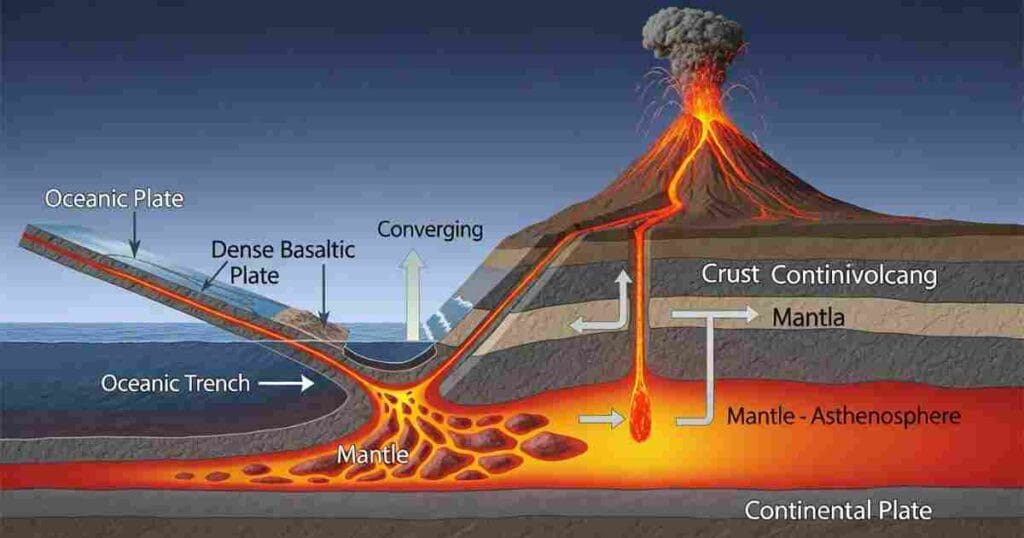
Sometimes, an ocean plate crashes into a land plate. The ocean plate is heavier, so it sinks underneath the land.
As it sinks deep into the Earth, it gets hot and melts into magma.
This hot magma rises up and blasts out of the top. A volcano is born.Shutterstock Explore
3.4 The Shake: Earthquakes
Sometimes, plates don’t crash head-on. Sometimes they slide past each other side-to-side.
Imagine rubbing two pieces of rough sandpaper together. They don’t slide smoothly. They get stuck. You have to push harder and harder. Suddenly—JERK!—they slip forward quickly.
That “jerk” is an Earthquake.
The plates get stuck for years, building up energy. When they finally snap free, the ground shakes violently.
3.5 Why This Chapter Is Important
Volcanoes and earthquakes seem scary and destructive. You might ask: “Why did Earth have to be built this way?”
But without this movement, Earth would die.
- Volcanoes release gases that help keep our atmosphere thick and warm.
- Plate movement pushes old rocks down to melt and brings new nutrients up to the surface.
This system is Earth’s way of recycling itself. It keeps the planet active and ready for life.
Quick Revision Box
| Feature | What is it? |
| Pangaea | The ancient super-continent before it broke apart. |
| Tectonic Plates | Giant pieces of Earth’s crust that fit together like a puzzle. |
| Mantle Convection | The hot, moving rock underneath that makes the plates move. |
| Mountain Building | When two plates crash and wrinkle up. |
| Volcano | When a plate sinks, melts, and magma rises up. |
| Earthquake | When two sliding plates get stuck and then jerk free. |
One Line to Remember
“The ground is not solid; we are floating on giant rock rafts that crash, pull apart, and slide to create mountains, volcanoes, and earthquakes.”
Read our All Earth science series Article.
- Earth Science Topics Full Explanation – Complete Learning Series
- Article 1 :- Earth Explained Simply : How Our Blue Planet Works
- Article 2 :- How Earth Was Formed: The 4.6 Billion Year Story Explained in Simple Words
- Article 3 :- Why Earthquakes and Volcanoes Happen – Earth’s Moving Plates Explained
- Article 4 :- Rocks, Minerals, Gold & Diamonds – What Is Under Our Feet?
- Article 5 :- Fossils Explained – How Scientists Read Earth’s Past From Stones
- Article 6 :- Oceans, Rivers and the Water Cycle – The Life System of Earth
- Article 7 :- Weather and Atmosphere Explained – Clouds, Rain, Storms & Sky Science
- Article 8 :- Climate Change and Global Warming Explained in Easy Language
- Article 9 :- Solar System Explained – Earth’s Place in Space
- Article 10 :- Natural Resources, Pollution & How to Save Earth for the Future
Earth Science Topics – Full eBook
Complete and easy Earth Science book. Perfect for students and beginners.
Buy Now