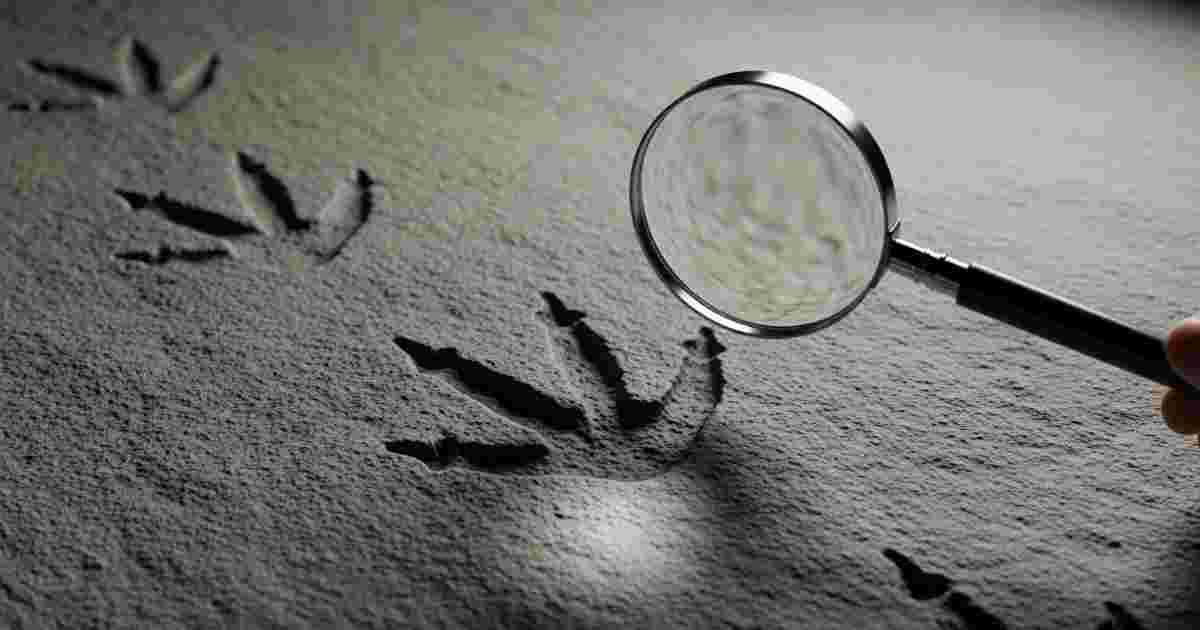

This is a 5th article of Earth science Topics series in this article we discuss the following topics that are given below.
In this chapter, we will open Earth’s oldest diary to find:
- The Stone Pages: How layers of dirt turn into pages of history.
- The Lucky Winners: Why becoming a fossil is like winning the lottery.
- Not Just Bones: Why footprints and poop are important too!
- The Snapshot: How we know what the ancient world looked like.
- The Clock: How scientists figure out how old a dinosaur is.
Introduction: Imagine if you kept a diary every day for 4 billion years. That would be a huge stack of paper! Earth has a diary, too. But it isn’t written with ink on paper. It is written with bones in stone. Let’s learn how to read it.
Table of Contents
5.1 The Earth is a Book (Stratigraphy)
In Chapter 4, we learned about Sedimentary Rocks (the sandwich rocks).
Sand and mud settle in layers at the bottom of the ocean.
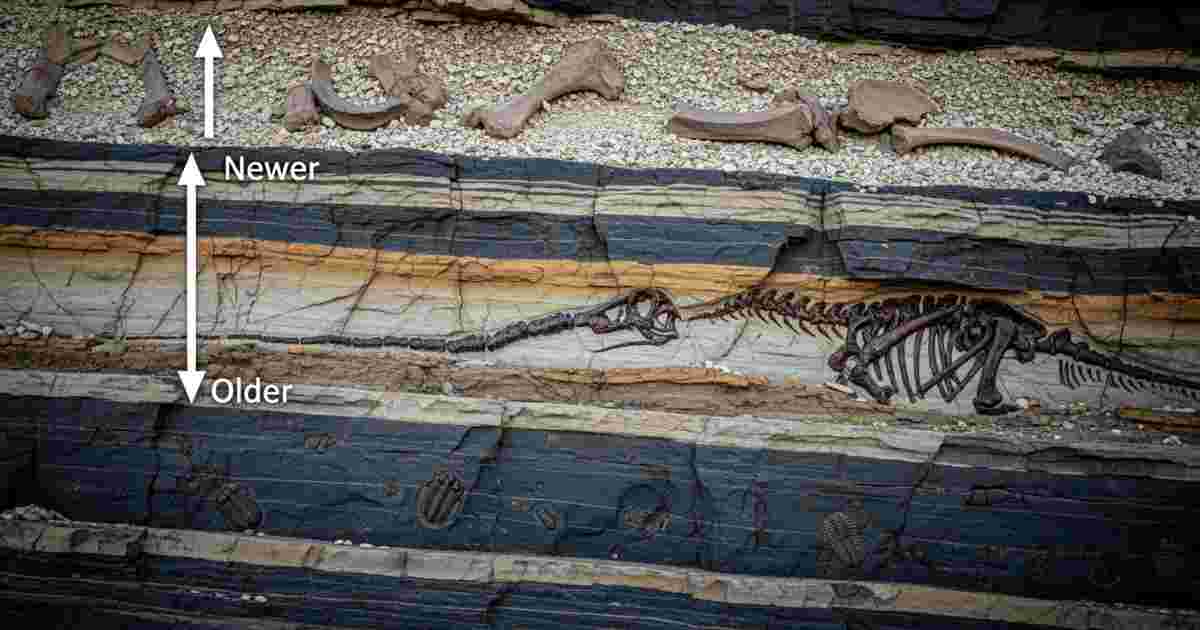
- Layer 1 falls first (The Bottom).
- Layer 2 falls on top of it.
- Layer 3 falls on top of that.
This is the most important rule in reading Earth’s history:
The deeper you go, the older it is.
- The Bottom Layer is the first page of the book (Oldest).
- The Top Layer is the last page of the book (Newest).
If you find a T-Rex bone deep underground and a Woolly Mammoth bone near the top, you know the T-Rex lived before the Mammoth.
5.2 What Exactly is a Fossil?
When you hear “fossil,” you probably think of a big white dinosaur skeleton in a museum.
But a fossil is any evidence of ancient life preserved in rock.
It doesn’t have to be a bone. It can be:
- A shell.
- A leaf print.
- A mosquito trapped in amber (tree sap).
- Even dinosaur poop! (Scientists call this Coprolite).
The Big Secret:
Most “dinosaur bones” in museums are not actually bones. They are rocks!
The original bone rotted away millions of years ago, and rock minerals filled the empty space. It is a “stone copy” of the bone.
5.3 How to Turn a Dinosaur into Stone
Becoming a fossil is very, very hard. In fact, it is like winning the lottery.
If a dinosaur dies in a forest, it usually gets eaten or rots away. No fossil.
To make a fossil, you need a perfect accident.
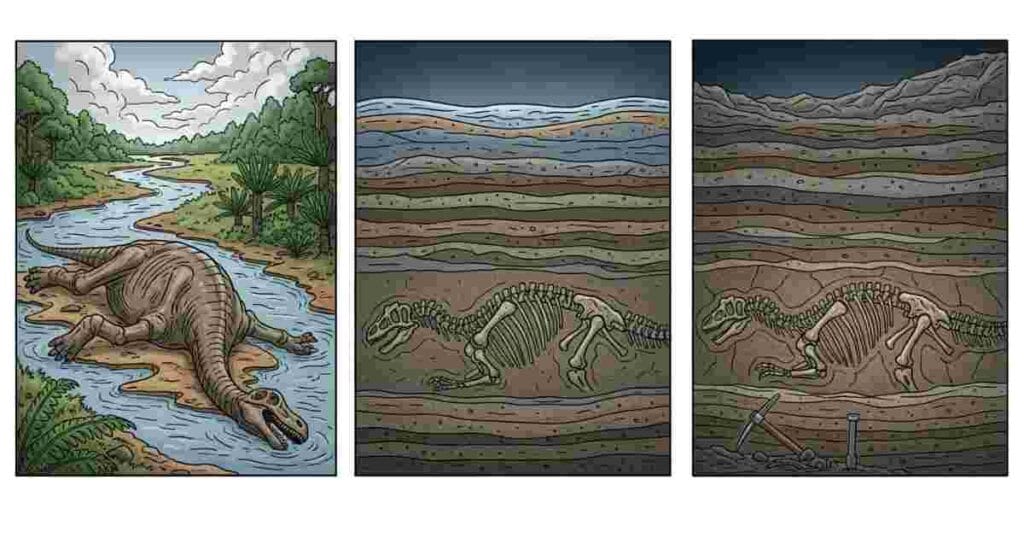
The 3-Step Recipe:
- The Burial: The animal must die and immediately get covered by mud or sand (usually at the bottom of a lake or ocean). This stops it from rotting.
- The Pressure: Over millions of years, more mud piles on top. The mud turns into hard rock.
- The Swap (Mineralization): Water seeps through the rock. It dissolves the bone and replaces it with minerals (like calcium and silica). The bone turns to stone.
5.4 Types of Fossils: Body vs. Trace
Scientists divide fossils into two teams.
Team A: Body Fossils
These are parts of the animal’s actual body.
- Examples: Teeth, claws, skulls, shells, or bones.
- What they tell us: What the animal looked like.
Team B: Trace Fossils
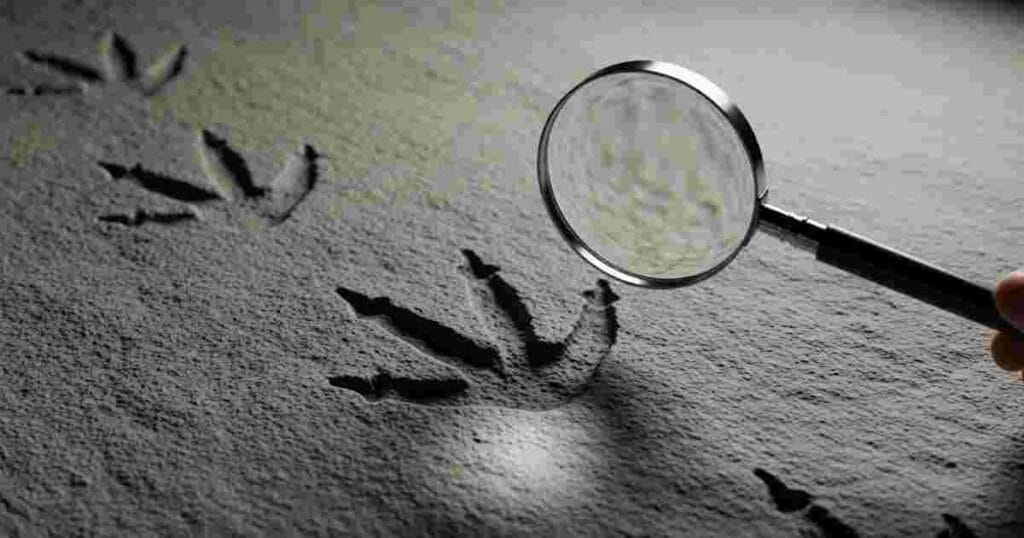
These are marks left behind by the animal while it was alive.
- Examples: Footprints, scratch marks, nests, or poop.
- What they tell us: How the animal behaved.
💡 Think about it: A T-Rex skeleton tells us it had big legs. But T-Rex footprints tell us how fast it could run!
5.5 How Do We Know How Old It Is?
If you find a fossil, how do you know if it is 1 million years old or 100 million years old?
Scientists use a special “Atomic Clock.”
Everything alive has a tiny bit of radiation in it (don’t worry, it’s safe!). When an animal dies, that radiation slowly disappears at a steady speed.
By measuring how much radiation is left in the rock around the fossil, scientists can calculate its age. This is called Radiometric Dating.
5.6 Why This Chapter Is Important
Without fossils, we would have no idea that dinosaurs, giant sharks, or woolly mammoths ever existed. Humans were not there to take photos.
The Stone Diary is the only record we have.
It teaches us that:
- Life on Earth is always changing.
- Giant creatures ruled the world long before us.
- Extinction happens (we will learn about this in the next chapter!).
Quick Revision Box
| Term | Meaning |
|---|---|
| Fossil | Any remains or trace of ancient life preserved in rock. |
| Stratigraphy | Reading the age of rocks by looking at the layers (Bottom = Oldest). |
| Mineralization | The process where bone is replaced by rock minerals. |
| Body Fossil | Parts of the animal (Bones, teeth). |
| Trace Fossil | Evidence of activity (Footprints, nests). |
| Paleontologist | A scientist who studies fossils |
One Line to Remember
“Fossils are not just old bones; they are the stone pages of Earth’s diary that tell us the story of life before humans.”
Read our All Earth science series Article.
- Earth Science Topics Full Explanation – Complete Learning Series
- Article 1 :- Earth Explained Simply : How Our Blue Planet Works
- Article 2 :- How Earth Was Formed: The 4.6 Billion Year Story Explained in Simple Words
- Article 3 :- Why Earthquakes and Volcanoes Happen – Earth’s Moving Plates Explained
- Article 4 :- Rocks, Minerals, Gold & Diamonds – What Is Under Our Feet?
- Article 5 :- Fossils Explained – How Scientists Read Earth’s Past From Stones
- Article 6 :- Oceans, Rivers and the Water Cycle – The Life System of Earth
- Article 7 :- Weather and Atmosphere Explained – Clouds, Rain, Storms & Sky Science
- Article 8 :- Climate Change and Global Warming Explained in Easy Language
- Article 9 :- Solar System Explained – Earth’s Place in Space
- Article 10 :- Natural Resources, Pollution & How to Save Earth for the Future
Earth Science Topics – Full eBook
Complete and easy Earth Science book. Perfect for students and beginners.
Buy Now