This is a First article of Earth science Topics series in this article we discuss the following topics that are given below.
In this article, we will discover:
- The View from Space: Why Earth looks like a glowing blue marble.
- The Perfect Spot: Why Earth is not too hot and not too cold.
- Inside the Planet: What lies beneath your feet (it’s not just rock!).
- The Invisible Shield: How Earth protects us from space danger.
- The Four Systems: How land, water, air, and life work together.
Introduction: Imagine you are an alien visiting our Solar System. You pass giant gas planets and red dusty rocks. Suddenly, you see it—a beautiful, shining blue ball. This is Earth. Let’s open the hood and see how this amazing machine works.
Table of Contents
1.1 The Blue Jewel of Space
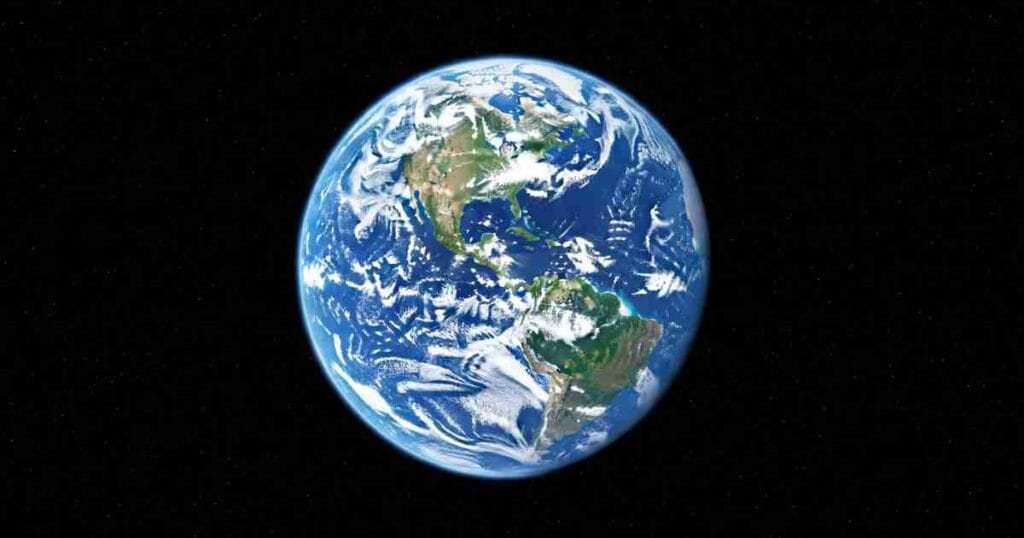
If you look at Earth from the Moon, it looks like a bright blue jewel hanging in the darkness.
Why is it blue?
Because of Water.
Water covers 71% of our planet’s surface.1 No other planet in our solar system has liquid water on its surface like we do.
- The white swirls you see are clouds.
- The brown and green shapes are land.
- The vast blue is the ocean.
This water makes Earth sparkle like a diamond in the sun.
1.2 The Goldilocks Zone (Just Right)
Why is Earth the only planet with life?
The answer is Location, Location, Location.
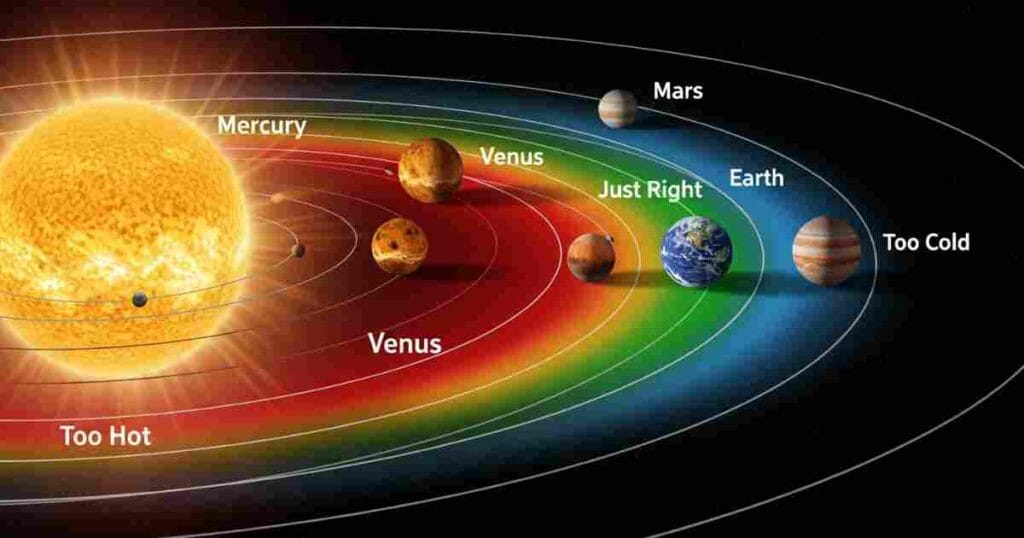
Scientists call Earth’s position the “Goldilocks Zone” (Habitable Zone).2
- Mercury and Venus are too close to the Sun. They are burning hot. Any water would boil away instantly.
- Mars is too far away. It is a frozen desert. Any water freezes into ice.
- Earth is right in the middle.
We are at the perfect distance where it is warm enough for water to flow, but cool enough so it doesn’t boil. Just like Goldilocks’ porridge—it is “Just Right.”
1.3 Inside the Earth (The Onion)
We walk on solid ground, so we think Earth is a solid rock all the way through. It is not.
Earth is made of layers, just like an onion or a hard-boiled egg.3
Let’s slice the Earth in half and look inside:
- The Crust (The Eggshell): This is the outside layer where we live.4 It is made of solid rock. Compared to the rest of the Earth, it is super thin—like the skin of an apple.
- The Mantle (The Egg White): Under the crust is a thick layer of heavy rock. It is very hot and moves slowly, like thick honey or toothpaste.
- The Core (The Yolk): The center of the Earth. It is made mostly of iron and nickel.
- Outer Core: Liquid metal that spins around.
- Inner Core: A solid ball of metal, hotter than the surface of the Sun!

1.4 The Invisible Shield (Magnetosphere)
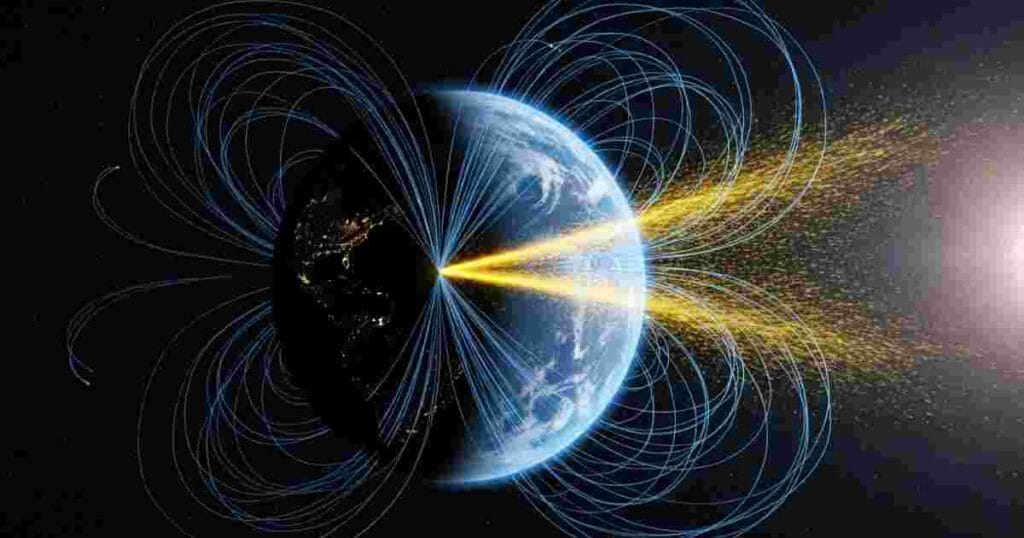
Space is a dangerous place. The Sun shoots out deadly radiation and solar winds constantly.5
So, why aren’t we cooked?
Because Earth has a superpower: A Magnetic Field.
Remember the Outer Core (the liquid metal) we just talked about? As it spins, it turns Earth into a giant magnet. This creates an invisible bubble around our planet.
When deadly solar wind hits Earth, this shield blocks it or deflects it to the poles (creating the Northern Lights).6 Without this shield, our atmosphere would be blown away.
1.5 The Four Spheres (Earth’s Team)
Earth works because four different systems interact with each other.8 Scientists call these “Spheres.” Think of them as team players.
- Lithosphere (Land): All the rocks, mountains, and ground.
- Hydrosphere (Water): All the oceans, rivers, lakes, and rain.
- Atmosphere (Air): The blanket of gases surrounding the planet.9
- Biosphere (Life): All the plants, animals, bacteria, and humans.
How they work together:
Imagine a tree.
- It grows in the dirt (Lithosphere).
- It drinks rain (Hydrosphere).
- It breathes carbon dioxide (Atmosphere).10
- It is alive (Biosphere).
If you remove one sphere, the others fall apart.

1.6 Why This Chapter Is Important
Before we learn history, we must understand the machine.
Earth is not just a rock floating in space. It is a complex, active, and fragile system. It has a hot engine inside (The Core), a cooling system (The Oceans), and a protective shield (The Magnetic Field).11
Now that we know how the machine works, we are ready to ask: How was it built?
(This leads us to Chapter 2: Stardust to Oceans).
Quick Revision Box
| Feature | Description |
| Blue Planet | Earth looks blue because 71% is water. |
| Goldilocks Zone | We are at the perfect distance from the Sun for liquid water. |
| The Crust | The thin, cold outer layer we live on. |
| The Mantle | The thick, hot, moving rock layer below us. |
| The Core | The metal center (Iron/Nickel) that creates gravity and magnetism. |
| Magnetosphere | The invisible shield protecting us from the Sun. |
Read our All Earth science series Article.
- Earth Science Topics Full Explanation – Complete Learning Series
- Article 1 :- Earth Explained Simply : How Our Blue Planet Works
- Article 2 :- How Earth Was Formed: The 4.6 Billion Year Story Explained in Simple Words
- Article 3 :- Why Earthquakes and Volcanoes Happen – Earth’s Moving Plates Explained
- Article 4 :- Rocks, Minerals, Gold & Diamonds – What Is Under Our Feet?
- Article 5 :- Fossils Explained – How Scientists Read Earth’s Past From Stones
- Article 6 :- Oceans, Rivers and the Water Cycle – The Life System of Earth
- Article 7 :- Weather and Atmosphere Explained – Clouds, Rain, Storms & Sky Science
- Article 8 :- Climate Change and Global Warming Explained in Easy Language
- Article 9 :- Solar System Explained – Earth’s Place in Space
- Article 10 :- Natural Resources, Pollution & How to Save Earth for the Future
One Line to Remember
“Earth is a rare ‘Goldilocks’ planet—perfectly placed, protected by a magnetic shield, and powered by four systems working in harmony.”
Earth Science Topics – Full eBook
Complete and easy Earth Science book. Perfect for students and beginners.
Buy Now