
Here is the final article, article 10.
This is the most important chapter because it connects everything we have learned (from stardust to oceans) and places the responsibility in our hands.
Chapter Overview
In this final chapter, we will learn:
- The New Kids: Why humans are the newest guests on an old planet.
- The Empty Cookie Jar: The difference between renewable and non-renewable resources.
- The Mess: How plastic and pollution hurt the Earth’s systems.
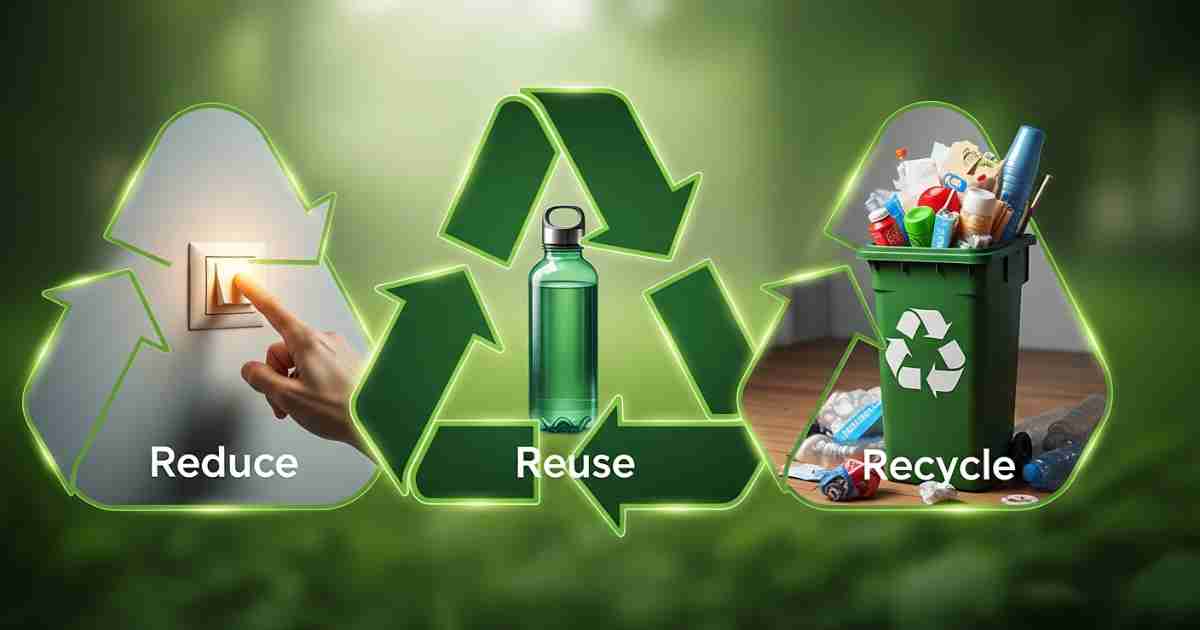
- The 3 R’s: Simple superpowers we can use to clean up the planet.
- The Promise: Our job as the future caretakers of the Blue Jewel.
Table of Contents
Introduction: Imagine you borrow your friend’s brand-new car. You drive it, enjoy it, and use the air conditioning. When you give it back, do you return it dirty, scratched, and empty of gas? No. You return it clean.
Earth is that car. We are borrowing it from future generations. This chapter is the instruction manual on how to take care of it.
10.1 The New Kids on the Block
We learned in Chapter 2 that Earth is 4.6 billion years old.
But humans (Homo Sapiens) have only been here for about 300,000 years.
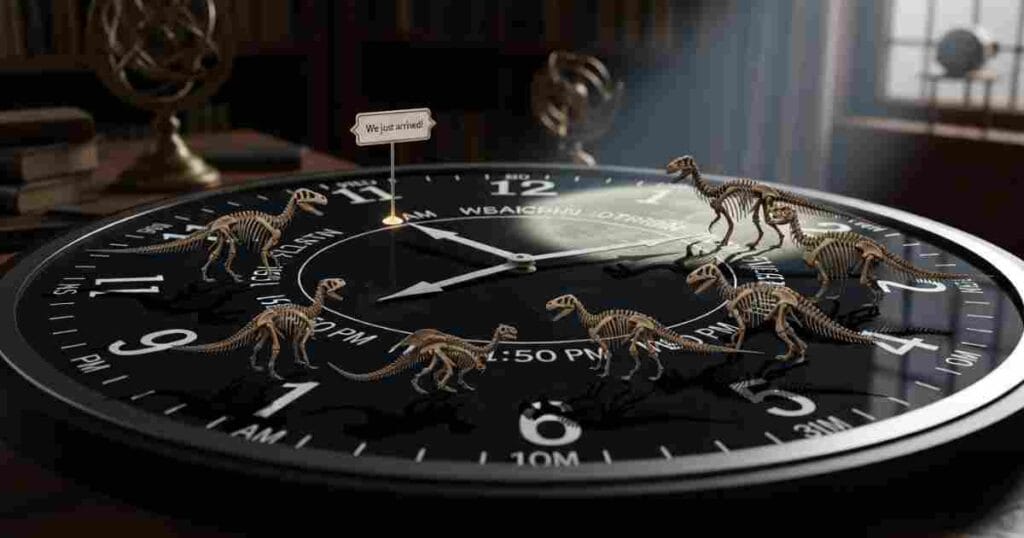
If Earth’s history was a 24-hour clock:
- Dinosaurs showed up at 11:00 PM.
- Humans showed up at 11:58 PM (just 2 minutes before midnight!).
We haven’t been here long, but we have changed the planet more than any other animal in history. We have built cities, drained rivers, and changed the air. Now, we must decide: Are we good guests or bad guests?
10.2 The Earth’s Pantry (Resources)
Earth gives us everything we need to survive. We call these Natural Resources.
They come in two types.
Type 1: Non-Renewable (The Cookie Jar)
These are things that run out. Once we use them, they are gone forever.
- Fossil Fuels: Coal, Oil, and Gas. (It took millions of years to make them; we burn them in seconds).
- Minerals: Gold, Iron, and Copper.
Analogy: Imagine a cookie jar. If you keep eating cookies without baking new ones, eventually the jar will be empty.
Type 2: Renewable (The Magic Fountain)
These are things that never run out (if we are careful).
- Solar Energy: The Sun will always shine.
- Wind Energy: The wind will always blow.
- Trees & Fish: If we plant new trees and don’t catch all the fish, they grow back.
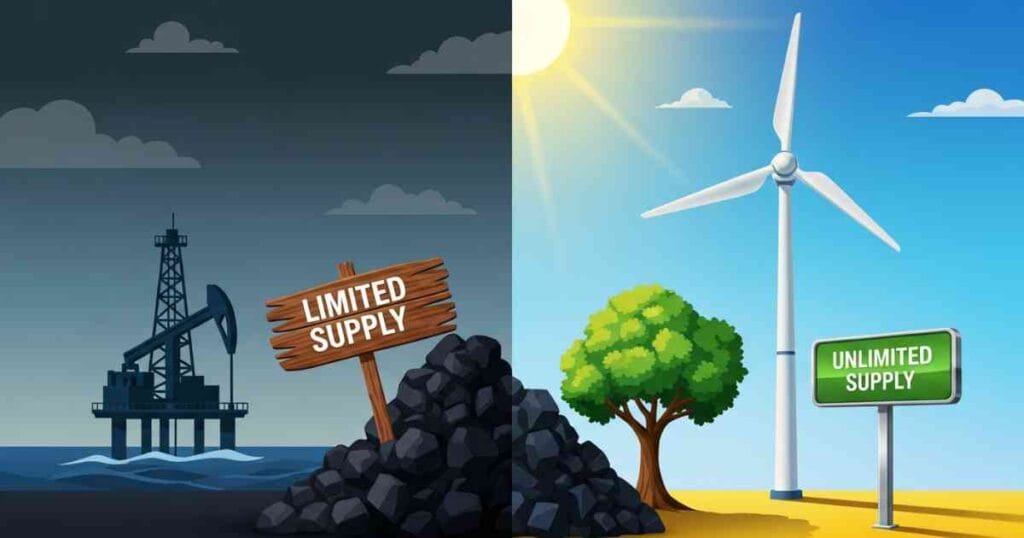
Image Explanation: To save the future, we must switch from the “Cookie Jar” (Oil) to the “Magic Fountain” (Sun and Wind).
10.3 The Mess We Make (Pollution)
Because we use so much energy and make so much “stuff,” we create waste.
- Air Pollution: Cars and factories release smoke. This makes the air hard to breathe and thickens the “Greenhouse Blanket” (causing Global Warming).
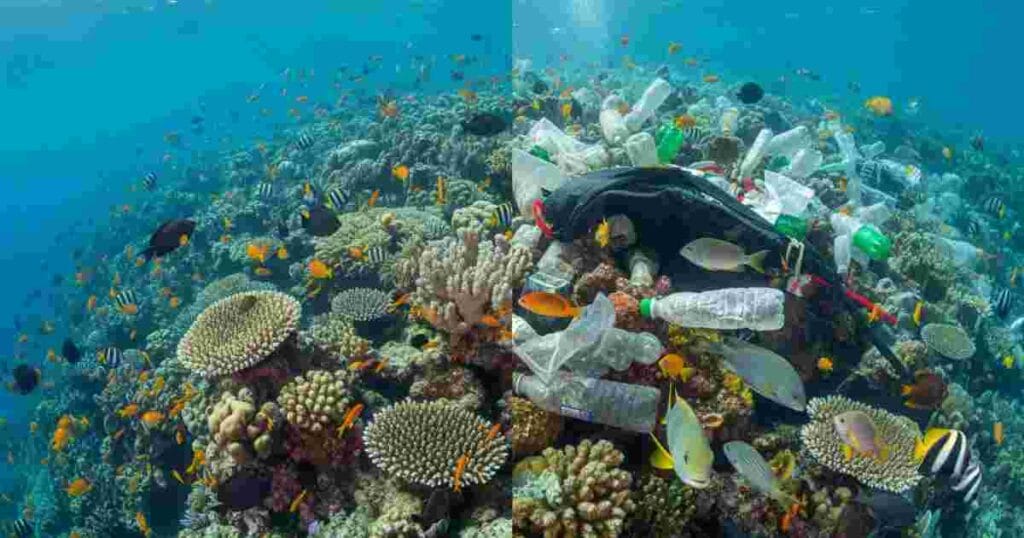
- Water Pollution: Chemicals and trash flow into rivers and oceans.
- Plastic: This is a big problem. Plastic does not rot. A plastic bottle you throw away today will still be there in 450 years.
⚠️ Fact: By 2050, scientists think there might be more plastic in the ocean (by weight) than fish!
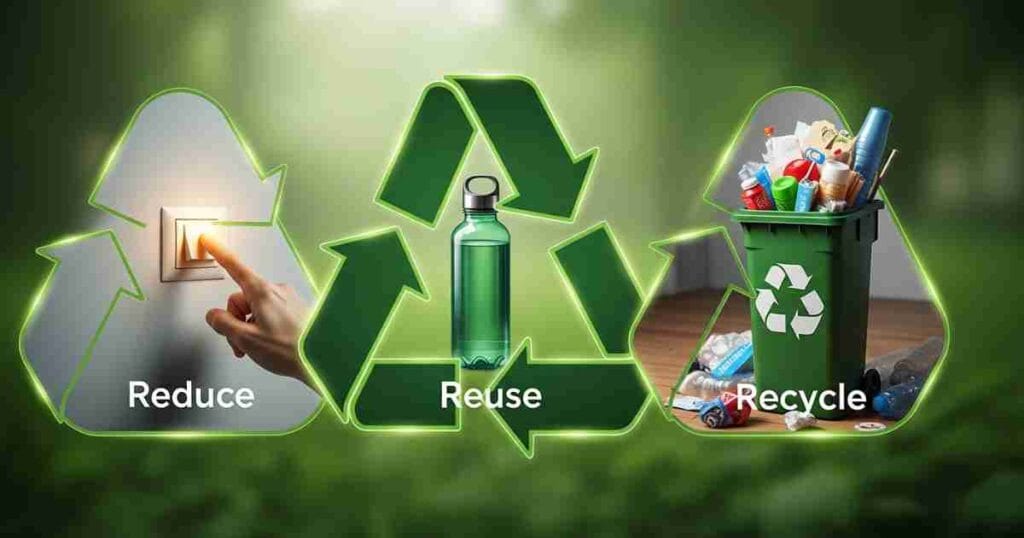
10.4 The Superpowers: Reduce, Reuse, Recycle
The problem sounds scary, but the solution is simple. You don’t need to be a superhero to save Earth. You just need the 3 R’s.
- Reduce (Use Less): This is the best one. Turn off the lights when you leave a room. Take shorter showers. Don’t buy things you don’t need.
- Reuse (Use Again): Don’t throw it away! Use a refillable water bottle instead of a plastic one. Fix broken toys instead of buying new ones.
- Recycle (Make New): Turn old paper, glass, and metal into new things. This saves energy and keeps trash out of the ground.
The 4th R: Rethink.
Invent new ways to live! Electric cars, solar panels, and biodegradable bags are all ways we are “rethinking” our future.Shutterstock
10.5 The Promise (Conclusion)
We have reached the end of our book.
We travelled from the fiery birth of Earth, through the age of dinosaurs, to the deep oceans and the starry sky.
We learned that Earth is a System.
- The rocks, the water, the air, and the life are all connected.
- If you hurt one part, you hurt the whole machine.
You are the first generation in history that understands how the Earth works and how to fix it.
The Earth is not just a rock. It is our home. It is our life support. And it is the only one we have.
Be a good Caretaker.
Read our All Earth science series Article.
- Earth Science Topics Full Explanation – Complete Learning Series
- Article 1 :- Earth Explained Simply : How Our Blue Planet Works
- Article 2 :- How Earth Was Formed: The 4.6 Billion Year Story Explained in Simple Words
- Article 3 :- Why Earthquakes and Volcanoes Happen – Earth’s Moving Plates Explained
- Article 4 :- Rocks, Minerals, Gold & Diamonds – What Is Under Our Feet?
- Article 5 :- Fossils Explained – How Scientists Read Earth’s Past From Stones
- Article 6 :- Oceans, Rivers and the Water Cycle – The Life System of Earth
- Article 7 :- Weather and Atmosphere Explained – Clouds, Rain, Storms & Sky Science
- Article 8 :- Climate Change and Global Warming Explained in Easy Language
- Article 9 :- Solar System Explained – Earth’s Place in Space
- Article 10 :- Natural Resources, Pollution & How to Save Earth for the Future
Quick Revision Box
| Term | Meaning |
| Non-Renewable | Resources that run out (Coal, Oil). |
| Renewable | Resources that come back (Sun, Wind, Trees). |
| Pollution | Waste that harms the land, air, or water. |
| Conservation | Protecting natural resources so they last. |
| Sustainability | Living in a way that doesn’t destroy the future. |
| The Caretaker | You. The person responsible for Earth’s safety. |
One Line to Remember
Earth Science Topics – Full eBook
Complete and easy Earth Science book. Perfect for students and beginners.
Buy Now“We did not inherit the Earth from our ancestors; we borrowed it from our children—so let’s return it better than we found it.”
THE END
Thank you for reading “The Story of How Earth Works.”