This is a 4th article of Earth science Topics series in this article we discuss the following topics that are given below.
Chapter Overview
In this chapter, we will unlock Earth’s secrets to find:
- The Ingredients: What rocks are actually made of.
- The Recycling Machine: How Earth turns old rocks into new ones (The Rock Cycle).
- Gold: Why gold is so rare and where volcanoes hide it.
- Diamonds: How common carbon turns into the hardest gem on Earth.
- The History Book: How rocks tell us stories about the past.
Introduction: Go outside and kick a rock. It just seems like a boring, grey lump, right? Wrong. That rock has been on an amazing adventure. It might have been inside a volcano, at the bottom of an ancient ocean, or part of a star. Rocks are not just dirt; they are Nature’s treasure chest. Let’s open it up.
Table of Contents
4.1 What is a Rock Made Of? (The Cookie Analogy)
If you hold a chocolate chip cookie, you know it isn’t just one thing. It’s made of ingredients: flour, sugar, butter, and chocolate chips.
A rock is exactly the same.
Rocks are made of ingredients called Minerals.
- The Rock = The Cookie.
- The Minerals = The flour, sugar, and chocolate chips.
If you look closely at a piece of granite (the rock often used for kitchen counters), you can see different speckles of color—pink, black, white, and grey. Each color is a different mineral stuck together.
Where do minerals come from?
Remember Chapter 2? We are made of stardust. Minerals are made of those same stardust atoms (elements) that formed the Earth.

Image Explanation: Just like a cookie is a mixture of ingredients, a rock is a mixture of minerals.
4.2 The Great Rock Recycling Machine
Earth does not like waste. It recycles everything, even rocks.
The ground beneath your feet is constantly changing because of the heat and movement we learned about in Chapter 3.
There are three main types of rocks, based on how they were “cooked”:
1. Igneous Rocks (Born from Fire)
These rocks used to be hot, liquid magma. When magma cools down and gets hard, it becomes Igneous rock.
- Think of melted chocolate that hardens in the fridge.
- Example: Basalt (the black rock near volcanoes).
2. Sedimentary Rocks (The Sandwich)
Wind and water break old rocks into tiny sand grains. This sand washes into the ocean and settles on the bottom in layers. Over millions of years, the layers get squashed and glued together.
- Think of a giant sandwich with layers of bread, cheese, and meat pressed flat.
- Example: Sandstone or Limestone.
3. Metamorphic Rocks (The Shape-Shifters)
Take an existing rock, bury it deep underground, heat it up, and squeeze it incredibly hard. It doesn’t melt, but it changes shape and becomes a new, tougher rock.
- Think of squishing pieces of playdough together in your warm hands.
- Example: Limestone turns into beautiful Marble.
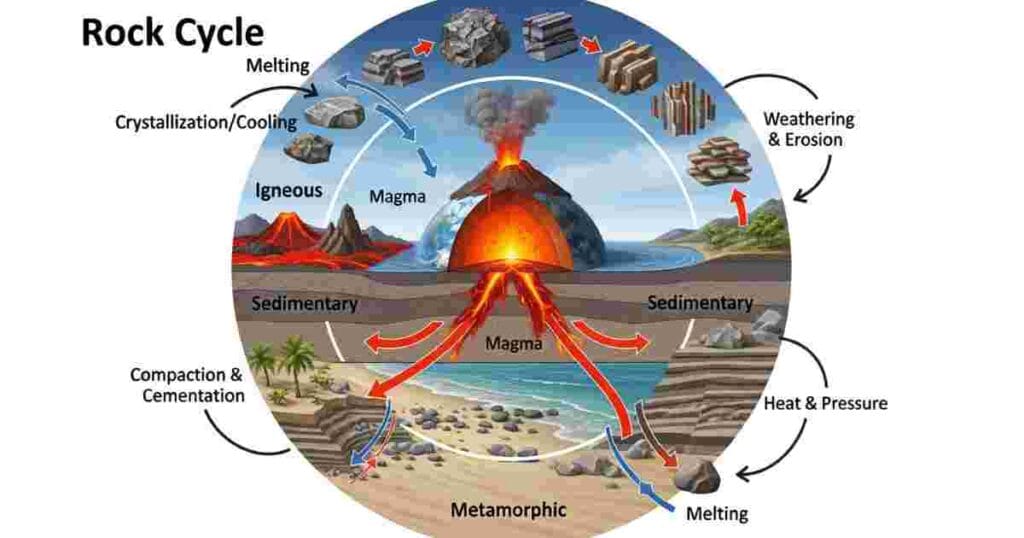
Image Explanation: Rocks never stay the same. They are always changing from one type to another over millions of years.
4.3 Where Does Gold Come From?
Everyone loves gold. It is shiny, it doesn’t rust, and it is very rare.
Why is it so rare?
Because when Earth was a molten fireball (back in Chapter 2), most of the heavy gold sank deep into the Core.
So, how do we get it?
We have to thank volcanoes again.
Deep underground, water gets heated by magma. This super-hot water moves through cracks in the rocks. It acts like a cleaning sponge, picking up tiny bits of gold along the way.
When this hot water gets near the surface, it cools down. It drops the gold inside the cracks. These trapped lines of gold are called Veins. Miners dig for these veins.

Image Explanation: Gold is brought up from the deep by hot water moving through cracks in the ground.
4.4 Diamonds are Forever (The Deep Pressure)
Diamonds are the hardest natural material on Earth.
But did you know a diamond is made of the exact same stuff as the black “lead” in your pencil? Both are made of Carbon.
The difference is Pressure.
To make a diamond, you need to take carbon and bury it 100 miles (160 km) deep in the Earth’s Mantle. You have to squeeze it with unimaginable force and heat.
The Diamond Elevator:
Diamonds form so deep that we could never dig down to get them. We have to wait for them to come to us.
Sometimes, a very deep, very fast volcano erupts. It acts like a high-speed elevator, blasting the diamonds up to the surface before they melt.
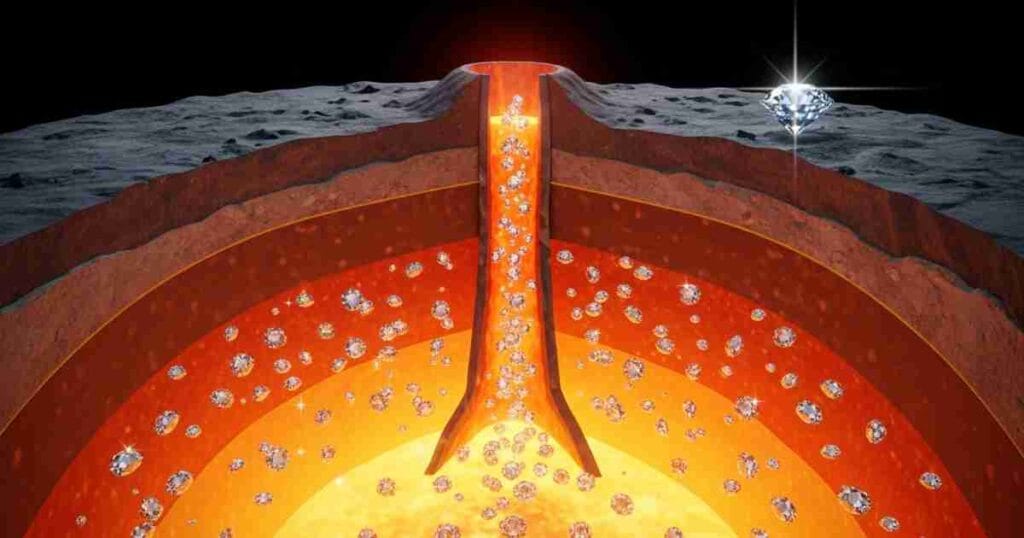
Image Explanation: Diamonds are created under extreme pressure deep inside Earth and delivered to the surface by deep volcanoes.
4.5 Why Rocks Act Like History Books
Remember Sedimentary rocks? The ones that form in layers like a sandwich?
These rocks are Earth’s history book.
When sand settles at the bottom of the ocean, sometimes a fish dies and gets buried in the sand. The soft parts rot away, but the bones turn into stone. This is a Fossil.
By looking at the layers of rock and the fossils trapped inside them, scientists can read the story of what Earth was like millions of years ago. The bottom layers are the oldest pages, and the top layers are the newest pages.
4.6 Why This Chapter Is Important
We use the treasures from rocks every single day.
- The metal in your phone.
- The glass in your windows (made from melted sand).
- The energy that powers your lights (often from coal, a sedimentary rock).
Our modern life is built entirely from the ingredients we dig out of Nature’s treasure chest.
Quick Revision Box
| Treasure | What is it? | How is it made? |
|---|---|---|
| Mineral | The ingredients of a rock. | Made of stardust elements. |
| Igneous Rock | Fire Rock. | Cooled down magma/lava. |
| Sedimentary Rock | Sandwich Rock. | Layers of sand and mud glued together. |
| Metamorphic Rock | Changing Rock. | Squished and heated deep underground. |
| Gold | Precious metal. | Brought up by hot underground water in cracks. |
| Diamond | Hardest gem. | Carbon squeezed intensely deep in the Mantle. |
One Line to Remember
“Rocks are not just boring grey lumps; they are recycled stardust that hold gold, diamonds, and the history of our planet.”
Read our All Earth science series Article.
- Earth Science Topics Full Explanation – Complete Learning Series
- Article 1 :- Earth Explained Simply : How Our Blue Planet Works
- Article 2 :- How Earth Was Formed: The 4.6 Billion Year Story Explained in Simple Words
- Article 3 :- Why Earthquakes and Volcanoes Happen – Earth’s Moving Plates Explained
- Article 4 :- Rocks, Minerals, Gold & Diamonds – What Is Under Our Feet?
- Article 5 :- Fossils Explained – How Scientists Read Earth’s Past From Stones
- Article 6 :- Oceans, Rivers and the Water Cycle – The Life System of Earth
- Article 7 :- Weather and Atmosphere Explained – Clouds, Rain, Storms & Sky Science
- Article 8 :- Climate Change and Global Warming Explained in Easy Language
- Article 9 :- Solar System Explained – Earth’s Place in Space
- Article 10 :- Natural Resources, Pollution & How to Save Earth for the Future
Earth Science Topics – Full eBook
Complete and easy Earth Science book. Perfect for students and beginners.
Buy Now