This is a 9th article of Earth science Topics series in this article we discuss the following topics that are given below.
Article Overview
In this Article, we will blast off to discover:
- The Boss: Why the Sun is the king of our family.
- The Rock Team: The four small planets closest to the Sun (including us!).
- The Gas Giants: The massive planets made of thick clouds and storms.
- The Night Watchman: Why the Moon changes its shape every night.
- The Big City: Our address in the giant galaxy called the Milky Way.
Table of Contents
Introduction: Imagine you are standing on your front porch. You can see your house, your neighbor’s house, and the street. Earth is our “house.” The Solar System is our “street.” And the Galaxy is the “city.” Let’s take a walk down our cosmic street to meet the neighbors.
9.1 The Boss of the Family (The Sun)
Our neighborhood has one ruler: The Sun.
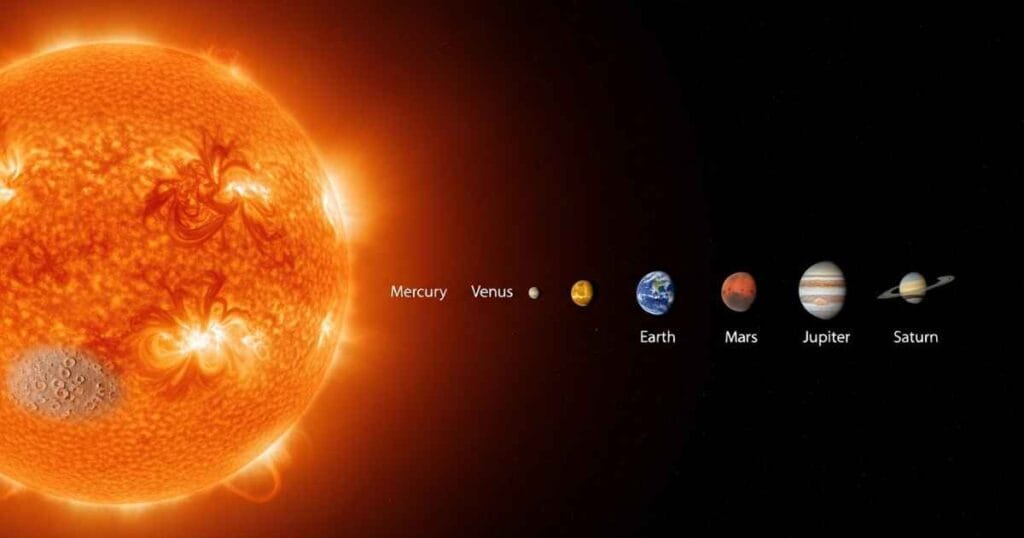
The Sun is not a planet. It is a Star. It is a giant ball of burning gas (Hydrogen and Helium) that holds everything together with its gravity.
How big is it?
Imagine the Sun is a basketball.
Earth would be the size of a tiny grain of sand.
You could fit 1.3 million Earths inside the Sun!
Without the Sun, there would be no light, no heat, and no life. It is the battery that powers the whole system.
9.2 The Inner Planets (The Rock Team)
The Solar System is divided into two teams.
Team 1: The Terrestrial Planets (Inner Planets).
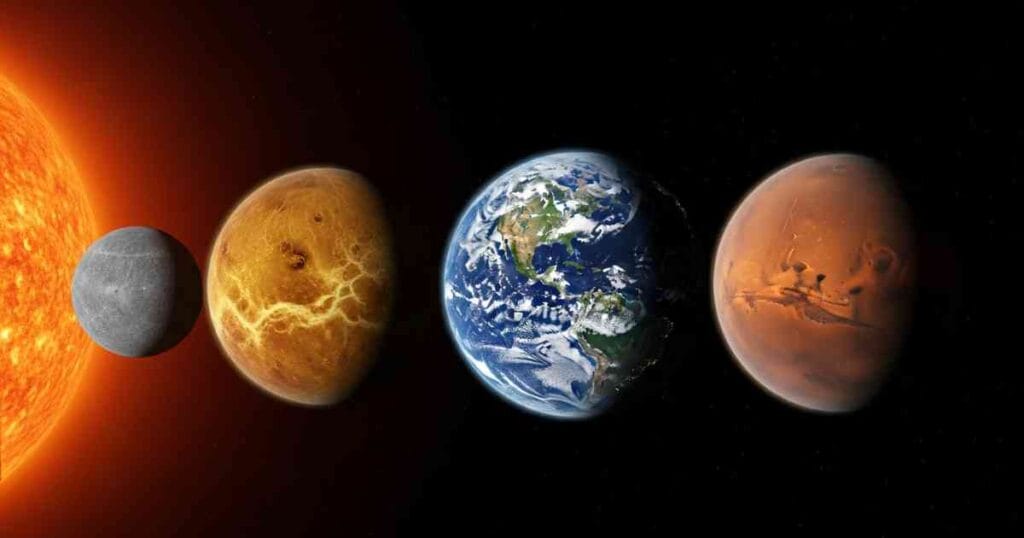
These are the four planets closest to the Sun. They are small and made of solid rock.
- Mercury (The Sprinter): Closest to the Sun. It is small, grey, and covered in craters like our Moon. It is extremely hot during the day and freezing at night.
- Venus (The Hot Twin): It is the same size as Earth, but don’t visit! It has thick clouds of acid that trap heat. It is the hottest planet of all (even hotter than Mercury!).
- Earth (The Blue Jewel): Our home. The only planet with liquid water and life.
- Mars (The Red Planet): It looks red because the dirt is rusty (iron oxide). It has giant volcanoes and dry riverbeds. Humans want to visit here next!
9.3 The Outer Planets (The Gas Giants)
Past Mars, there is a ring of rocks called the Asteroid Belt.
Beyond that, we meet Team 2: The Jovian Planets.
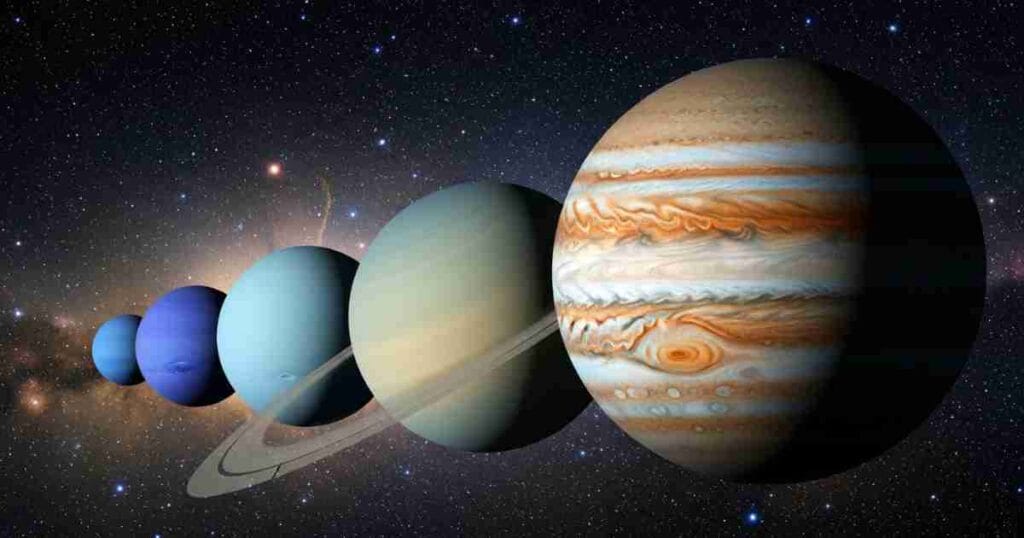
These planets do not have solid ground. They are made of gas and ice. You cannot stand on them—you would fall right through!
- Jupiter (The King): The biggest planet. It has a giant red spot which is actually a storm that has been raging for 300 years.
- Saturn (The Lord of the Rings): Famous for its beautiful, shiny rings made of ice and rock. It is so light that if you had a bathtub big enough, Saturn would float in it!
- Uranus (The Ice Giant): A cold, pale blue planet. It is strange because it spins on its side, like a rolling ball.
- Neptune (The Windy One): The furthest planet. It is dark blue and has the fastest winds in the solar system.
9.4 The Little Guys (Dwarf Planets & Moons)
What about Pluto?
Pluto used to be the 9th planet. But in 2006, scientists decided it was too small. Now, it is called a Dwarf Planet. It lives far out in the dark, icy edge of the neighborhood.
The Moon (Earth’s Best Friend):
Earth has one natural satellite: The Moon.
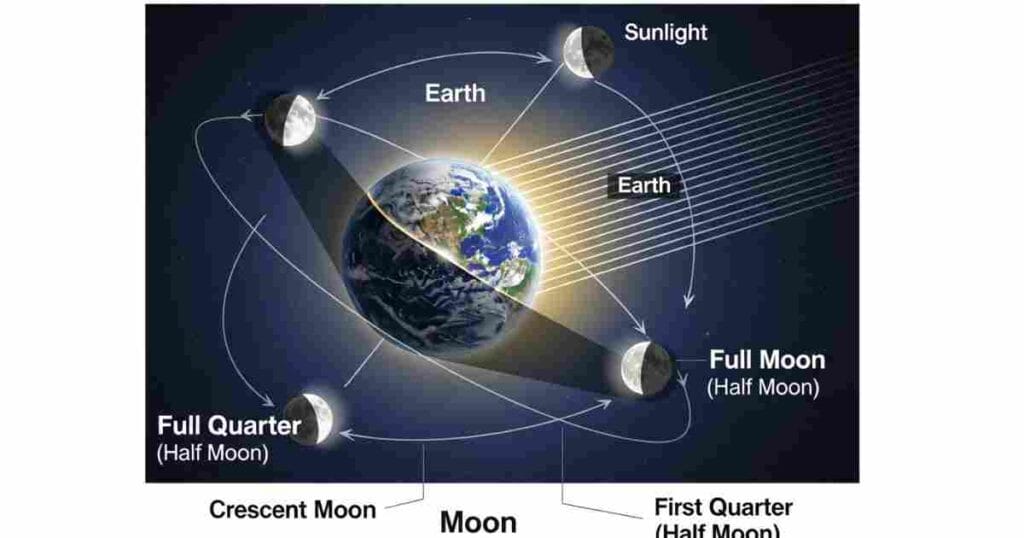
It does not make its own light. It acts like a mirror, reflecting sunlight down to us.
- Why does it change shape?The Moon is always a round ball. But as it travels around Earth, we see different amounts of the sunlit side. Sometimes we see the whole face (Full Moon), and sometimes we see nothing (New Moon).
9.5 Our Address in the City (The Milky Way)
Our Solar System seems huge. But in space, it is tiny.
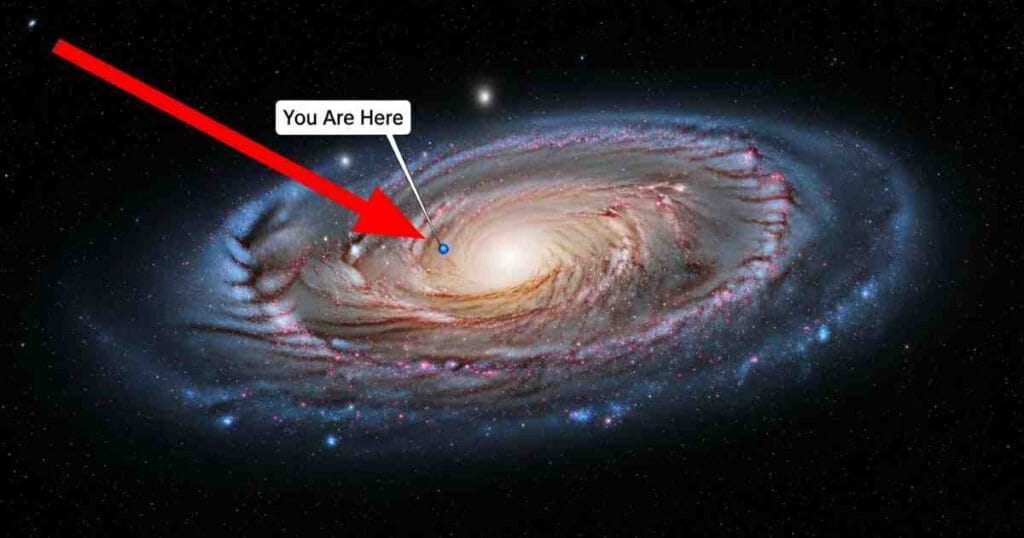
Our Sun is just one of 200 billion stars in a giant city called the Milky Way Galaxy.
If the Milky Way was the size of the United States, our Solar System would be the size of a coffee cup.
We live in a quiet suburb on one of the spiral arms of the galaxy.
And beyond the Milky Way? There are billions of other galaxies. The universe is bigger than we can imagine.
9.6 Why This Chapter Is Important
It is easy to think Earth is the center of everything.
But this chapter teaches us humility.
- We are one planet among eight.
- We orbit one star among billions.
We are travellers on a tiny blue spaceship floating through a magnificent, endless ocean of stars.
Quick Revision Box
| Name | Description |
| Sun | The star at the center. The boss. |
| Inner Planets | Mercury, Venus, Earth, Mars (Rock). |
| Outer Planets | Jupiter, Saturn, Uranus, Neptune (Gas). |
| Asteroid Belt | The ring of rocks between Mars and Jupiter. |
| Milky Way | The galaxy (city) where our Solar System lives. |
| Gravity | The invisible glue holding the neighborhood together. |
Read our All Earth science series Article.
- Earth Science Topics Full Explanation – Complete Learning Series
- Article 1 :- Earth Explained Simply : How Our Blue Planet Works
- Article 2 :- How Earth Was Formed: The 4.6 Billion Year Story Explained in Simple Words
- Article 3 :- Why Earthquakes and Volcanoes Happen – Earth’s Moving Plates Explained
- Article 4 :- Rocks, Minerals, Gold & Diamonds – What Is Under Our Feet?
- Article 5 :- Fossils Explained – How Scientists Read Earth’s Past From Stones
- Article 6 :- Oceans, Rivers and the Water Cycle – The Life System of Earth
- Article 7 :- Weather and Atmosphere Explained – Clouds, Rain, Storms & Sky Science
- Article 8 :- Climate Change and Global Warming Explained in Easy Language
- Article 9 :- Solar System Explained – Earth’s Place in Space
- Article 10 :- Natural Resources, Pollution & How to Save Earth for the Future
Earth Science Topics – Full eBook
Complete and easy Earth Science book. Perfect for students and beginners.
Buy NowOne Line to Remember
“Earth is part of a large cosmic family: four small rocks, four giant gas balls, and one burning star—all drifting together in the Milky Way.”