
This is a 7th article of Earth science Topics series in this article we discuss the following topics that are given below.
Table of Contents
Chapter Overview
In this chapter, we will look up to discover:
- The Invisible Blanket: Why air is not “empty space” but a heavy ocean.
- The Layer Cake: The different layers of the sky (from airplanes to space).
- Cloud Spotting: How to name the clouds by their shapes.
- The Anger of the Sky: How thunderstorms and lightning are born.
- The Blue & The Orange: Why the sky changes color at sunset.
Introduction: Look up. What do you see? It looks like empty space, doesn’t it? But it isn’t. You are actually walking at the bottom of a giant ocean. But this ocean isn’t made of water—it is made of gas. We call it the Atmosphere. Let’s swim up and explore it.
7.1 Living at the Bottom of an Air Ocean
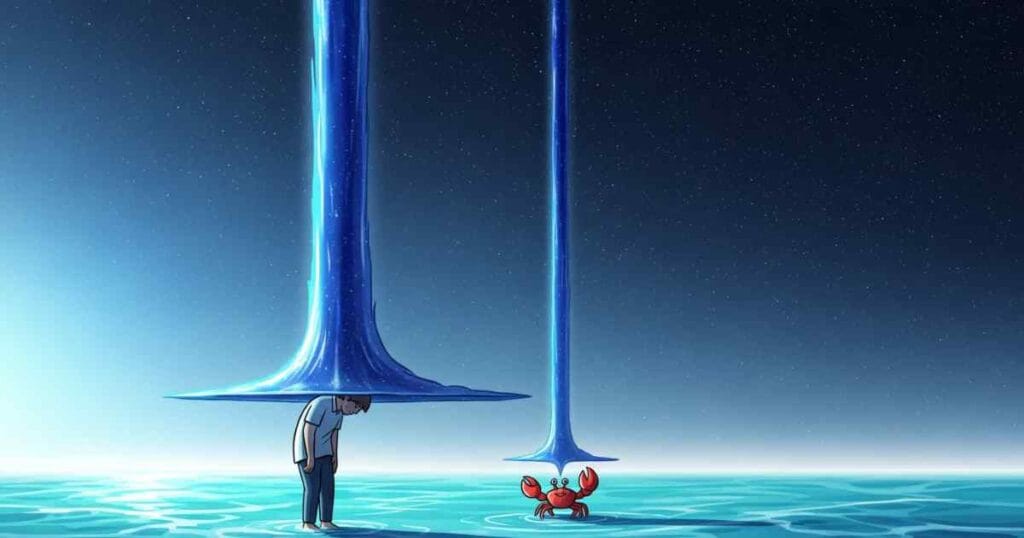
Imagine a crab walking on the bottom of the sea. It has tons of water pushing down on it, but the crab is used to it.
We are the crabs.
We live at the bottom of an “Ocean of Air.” Even though you can’t see air, it is heavy. It pushes on your shoulders all day long. We call this Air Pressure.
- If you go up a high mountain, there is less air above you. The pressure is lower.
- That is why it is harder to breathe on Mount Everest—the “ocean” is shallower there!
What is Air made of?
It is a mixture of invisible gases:
- Nitrogen (78%): The main ingredient.
- Oxygen (21%): The stuff we breathe.
- Other (1%): A tiny pinch of argon, carbon dioxide, and water vapor.
7.2 The Layer Cake (The Atmosphere)
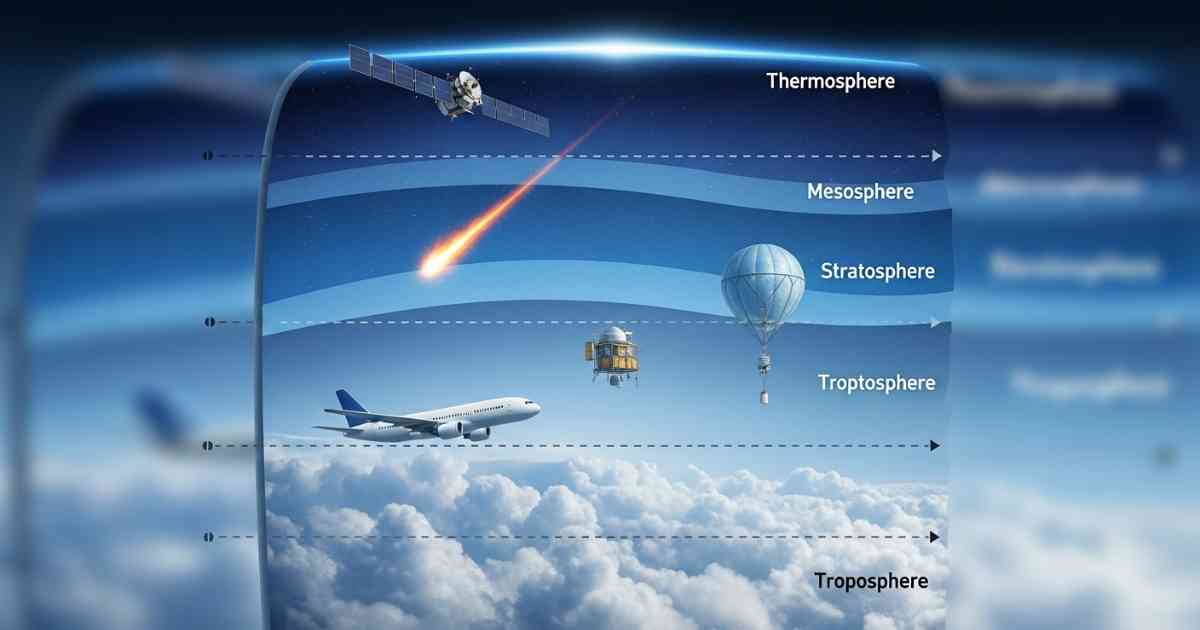
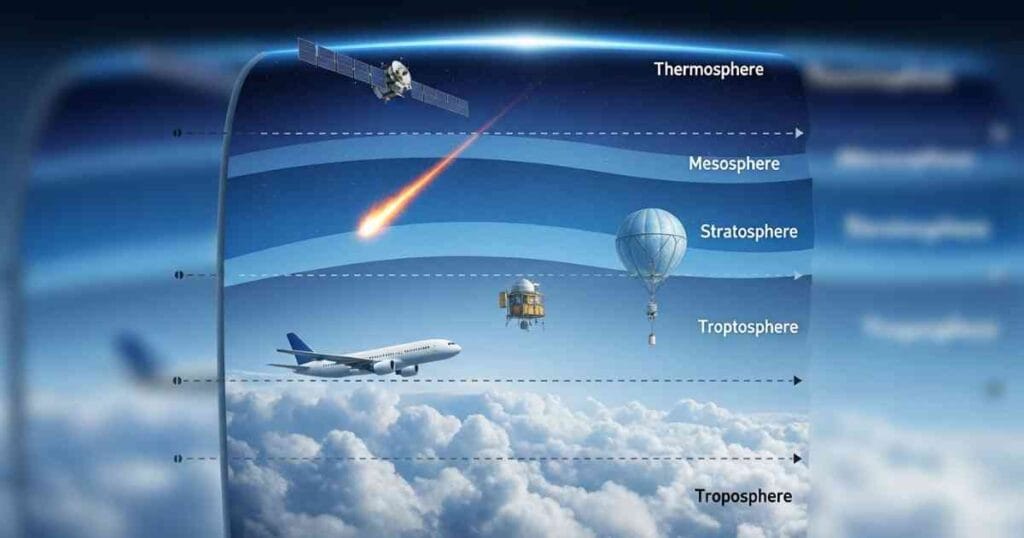
The sky isn’t just one big blob of air. It has layers, just like a birthday cake.
As you go higher, the rules change.
- Troposphere (The Weather Layer): This is the bottom layer where we live. All the clouds, rain, birds, and airplanes are here. It is the only layer with enough air to breathe.
- Stratosphere (The Shield): This layer is calm and dry. It contains the Ozone Layer, which acts like giant sunglasses, protecting Earth from the Sun’s harmful rays.
- Mesosphere (The Meteor Burner): This is where space rocks (meteors) burn up, creating “shooting stars.”
- Thermosphere (The Edge of Space): The air is super thin here. This is where satellites and the Space Station fly.
7.3 Cloud Spotting: Reading the Sky
Clouds are the messengers of the weather. If you know how to read them, you can predict if it will rain.
Clouds are just floating piles of tiny water droplets (remember Chapter 6?).
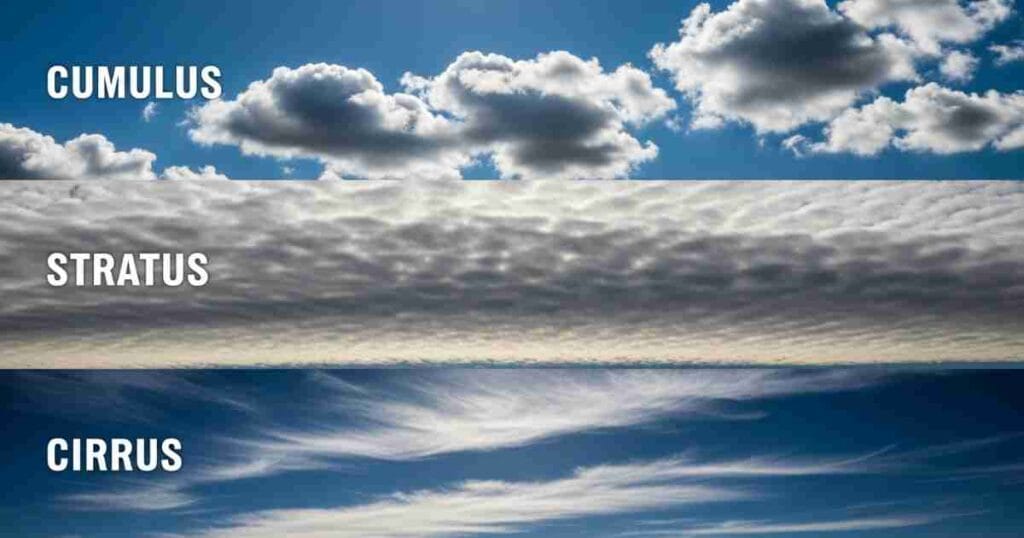
There are three main types:
- Cumulus (Cotton Balls): These are big, puffy, white clouds that look like floating cotton candy. They usually mean good weather.
- Stratus (The Blanket): These are flat, grey clouds that cover the whole sky like a blanket. They block the sun and usually bring light rain or fog.
- Cirrus (Feathers): These are very high, thin, wispy clouds that look like feathers or hair. They are made of ice crystals! They mean the weather is changing.
7.4 When the Air Gets Angry (Storms)
Sometimes, the air moves fast. We call this Wind.
Wind happens when air rushes from a “High Pressure” place to a “Low Pressure” place. Think of air rushing out of a balloon.
How a Thunderstorm is born:
- Hot Air Rises: The sun heats the ground. The hot air rises up quickly (like steam from a kettle).
- The Monster Cloud: The rising air cools down and builds a giant, tall cloud called a Cumulonimbus (Thunderhead).
- The Crash: Inside the cloud, ice and water droplets bump into each other. This creates static electricity.
- ZAP!: The electricity jumps from the cloud to the ground. That is Lightning. The explosion of air around it makes the sound of Thunder.
7.5 Why is the Sky Blue? (The Scatter Trick)
This is the most famous question in science!
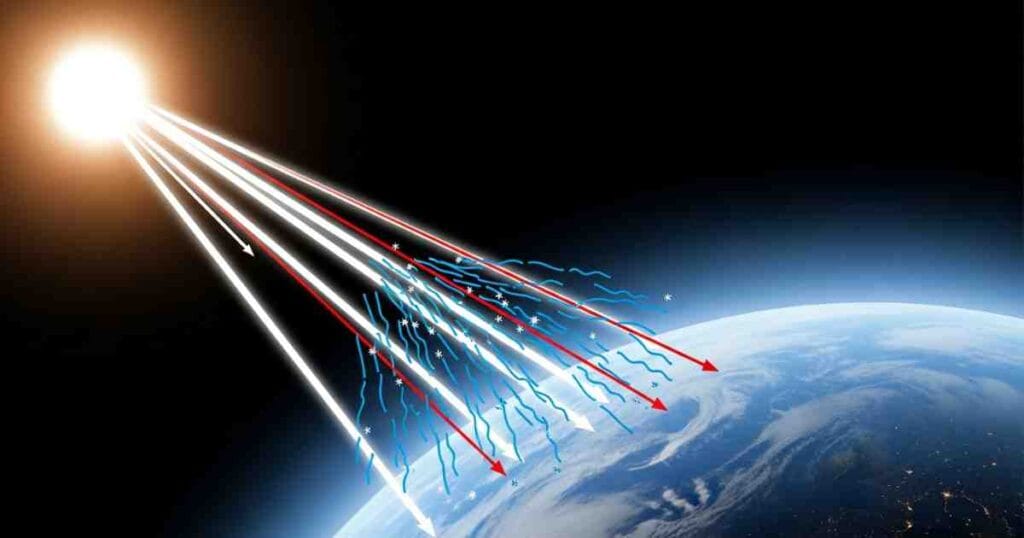
Sunlight looks white, but it is actually a rainbow of all colors mixed together (Red, Orange, Yellow, Green, Blue, Indigo, Violet).
When sunlight hits our atmosphere, it crashes into the gas molecules (Nitrogen).
- Red and Yellow colors surf right through the gas.
- Blue color crashes into the gas and scatters everywhere.
So, when you look up, you are seeing that scattered blue light dancing around in the sky.
Why is Sunset Red?
At sunset, the sun is lower. The light has to travel through more atmosphere to reach you. The blue light gets scattered away completely, leaving only the red and orange light to reach your eyes.
7.6 Why This Chapter Is Important
The atmosphere is our Life Support System.
- It gives us oxygen to breathe.
- It protects us from space rocks (meteors).
- It blocks deadly solar rays (Ozone).
- It keeps the planet warm like a blanket.
Without this “Ocean of Air,” Earth would be as cold and dead as the Moon.
Quick Revision Box
| Term | What is it? |
|---|---|
| Atmosphere | The blanket of gas surrounding Earth. |
| Air Pressure | The weight of the air pushing down on us. |
| Troposphere | The bottom layer where weather happens. |
| Ozone Layer | The shield that blocks harmful sun rays. |
| Cumulus | Puffy, happy clouds (Good weather). |
| Cumulonimbus | Giant storm clouds (Lightning/Thunder). |
| Wind | Air moving from High Pressure to Low Pressure. |
Read our All Earth science series Article.
- Earth Science Topics Full Explanation – Complete Learning Series
- Article 1 :- Earth Explained Simply : How Our Blue Planet Works
- Article 2 :- How Earth Was Formed: The 4.6 Billion Year Story Explained in Simple Words
- Article 3 :- Why Earthquakes and Volcanoes Happen – Earth’s Moving Plates Explained
- Article 4 :- Rocks, Minerals, Gold & Diamonds – What Is Under Our Feet?
- Article 5 :- Fossils Explained – How Scientists Read Earth’s Past From Stones
- Article 6 :- Oceans, Rivers and the Water Cycle – The Life System of Earth
- Article 7 :- Weather and Atmosphere Explained – Clouds, Rain, Storms & Sky Science
- Article 8 :- Climate Change and Global Warming Explained in Easy Language
- Article 9 :- Solar System Explained – Earth’s Place in Space
- Article 10 :- Natural Resources, Pollution & How to Save Earth for the Future
Earth Science Topics – Full eBook
Complete and easy Earth Science book. Perfect for students and beginners.
Buy NowOne Line to Remember
“We don’t just live on the Earth; we live inside a protective ocean of air that gives us breath, weather, and a beautiful blue sky.”