
Quick Summary
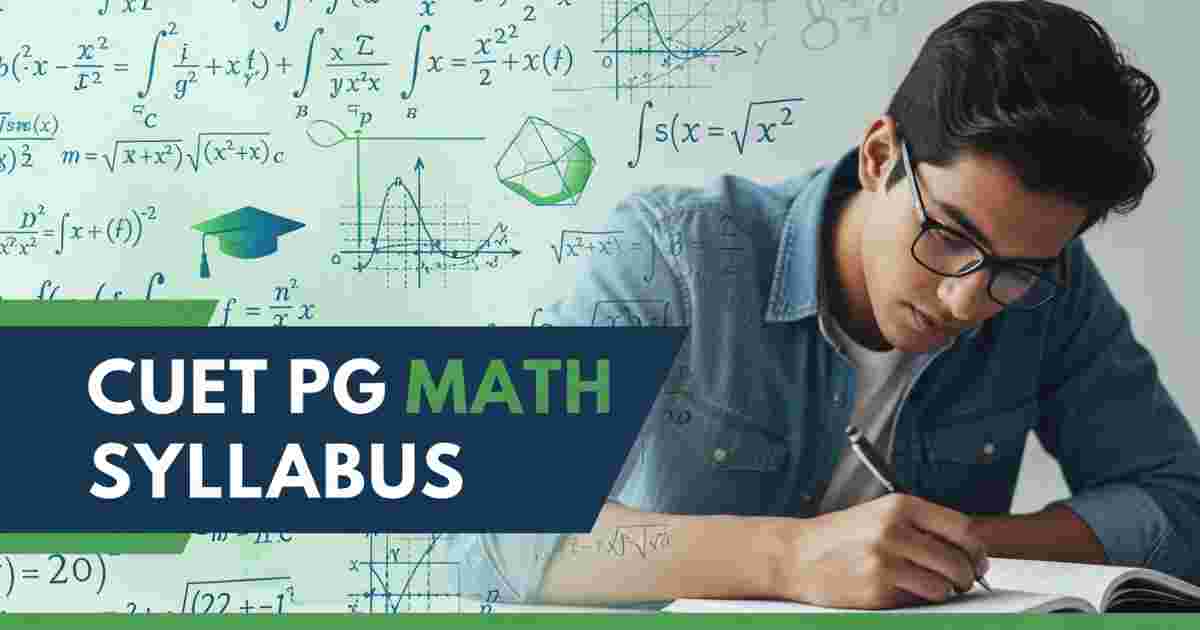
The Cuet pg math syllabus (Paper Code: SCQP19) is for students who want to study M.Sc. Mathematics. The exam has 75 questions only from Mathematics. There is no General Test. The syllabus has big topics like Algebra, Real Analysis, Complex Analysis, Calculus, Differential Equations, Vector Calculus, and Linear Programming. The exam time is 105 minutes.
Table of Contents
Introduction: Math Made Easy
Hello students! Do you want to do a Master’s degree (M.Sc.) in Mathematics from a big college like DU, BHU, or JNU? If yes, you need to pass the CUET PG exam. To pass, you must know the Cuet pg math syllabus very well.
Some students think the syllabus is very hard. But do not worry! In this blog post, we have written the full Cuet pg math syllabus in very simple English. We have used the official syllabus PDF (SCQP19) to give you the correct topics.
If you read this page, you will know exactly what to study to get top marks. Let’s start!
CUET PG Math Exam Pattern (Simple Table)
Before looking at the chapters, you must know the exam rules. The Cuet pg math syllabus follows this pattern:
| Feature | Details |
| Paper Code | SCQP19 |
| Total Questions | 75 Questions |
| Subject | Only Mathematics (No General Knowledge) |
| Marks | +4 Marks for Correct Answer |
| Negative Marking | -1 Mark for Wrong Answer |
| Time | 105 Minutes (1 Hour 45 Mins) |
| Language | English and Hindi |
Important: In the new pattern, there is no Part A. You only need to study Math topics from the Cuet pg math syllabus.
Complete Topic-Wise CUET PG Math Syllabus
Here is the full syllabus. We have divided it into topic lists just like the official PDF.
1. Algebra
This is a very big and important part of the Cuet pg math syllabus. It has two parts: Groups and Linear Algebra.
- Groups: Groups, subgroups, Abelian groups, non-abelian groups, cyclic groups, permutation groups. Normal subgroups, Lagrange’s Theorem for finite groups, group homomorphism and quotient groups.
- Rings & Fields: Rings, Subrings, Ideal, Prime ideal; Maximal ideals; Fields, quotient field.
- Vector Spaces: Vector spaces, Linear dependence and Independence of vectors, basis, dimension, linear transformations.
- Matrices: Matrix representation with respect to an ordered basis, Range space and null space, rank-nullity theorem. Rank and inverse of a matrix, determinant, solutions of systems of linear equations, consistency conditions.
- Eigenvalues: Eigenvalues and eigenvectors. Cayley-Hamilton theorem. Symmetric, Skew symmetric, Hermitian, Skew-Hermitian, Orthogonal and Unitary matrices.
2. Real Analysis
This unit is about real numbers and series.
- Sequences: Sequences and series of real numbers. Convergent and divergent sequences, bounded and monotone sequences, Convergence criteria for sequences of real numbers, Cauchy sequences, absolute and conditional convergence.
- Series Tests: Tests of convergence for series of positive terms – comparison test, ratio test, root test, Leibnitz test for convergence of alternating series.
3. Functions of One Variable
This part talks about basic calculus concepts in the Cuet pg math syllabus.
- Basics: Limit, continuity, differentiation, Rolle’s Theorem, Cauchy’s Taylor’s theorem.
- Sets: Interior points, limit points, open sets, closed sets, bounded sets, connected sets, compact sets.
- Completeness: Completeness of R.
- Power Series: Power series (of real variable) including Taylor’s and Maclaurin’s, domain of convergence, term-wise differentiation and integration of power series.
4. Functions of Two Real Variables
Here, we study functions that have two variables (like x and y).
- Basics: Limit, continuity, partial derivatives, differentiability.
- Applications: Maxima and minima. Method of Lagrange multipliers.
- Theorems: Homogeneous functions including Euler’s theorem.
5. Complex Analysis
This unit deals with complex numbers (numbers with ‘i’).
- Basics: Functions of a complex Variable, Differentiability and analyticity, Cauchy Riemann Equations.
- Power Series: Power series as an analytic function.
- Integrals: Properties of line integrals, Goursat Theorem, Cauchy theorem, consequence of simply connectivity, index of a closed curves.
- Theorems: Cauchy’s integral formula, Morera’s theorem, Liouville’s theorem, Fundamental theorem of Algebra, Harmonic functions.
6. Integral Calculus
This is about finding areas and volumes using integration. A key part of the Cuet pg math syllabus.
- Basics: Integration as the inverse process of differentiation, definite integrals and their properties, Fundamental theorem of integral calculus.
- Multiple Integrals: Double and triple integrals, change of order of integration.
- Applications: Calculating surface areas and volumes using double integrals and applications. Calculating volumes using triple integrals and applications.
7. Differential Equations
This unit is about solving equations with derivatives.
- First Order: Ordinary differential equations of the first order of the form $y’ = f(x,y)$. Bernoulli’s equation, exact differential equations, integrating factor, Orthogonal trajectories.
- Homogeneous: Homogeneous differential equations-separable solutions.
- Higher Order: Linear differential equations of second and higher order with constant coefficients, method of variation of parameters. Cauchy-Euler equation.
8. Vector Calculus
This unit mixes vectors and calculus.
- Fields: Scalar and vector fields, gradient, divergence, curl and Laplacian.
- Integrals: Scalar line integrals and vector line integrals, scalar surface integrals and vector surface integrals.
- Theorems: Green’s, Stokes and Gauss theorems and their applications.
9. Linear Programming
This is the last unit of the Cuet pg math syllabus. It is about finding the best solution.
- Basics: Convex sets, extreme points, convex hull, hyper plane & polyhedral Sets, convex function and concave functions.
- LPP: Concept of basis, basic feasible solutions, Formulation of Linear Programming Problem (LPP), Graphical Method of LPP, Simplex Method.
Simple Tips to Study Cuet PG Math Syllabus
The Cuet pg math syllabus is long, but easy if you plan well. Here are 3 tips:
- Practice Formulas: Math is all about formulas. Make a small notebook and write all formulas from Algebra and Calculus there.
- Solve Problems: Do not just read the book. Solve 10 questions every day from different topics of the Cuet pg math syllabus.
- Focus on Easy Topics: “Linear Programming” and “Vector Calculus” are easier. Finish them first to get sure marks.
Frequently Asked Questions (FAQ)
Q: Is the Cuet pg math syllabus same for JNU and BHU?
A: Yes! The paper code is SCQP19. All central universities use this same syllabus.
Q: Are there any General Knowledge questions?
A: No. The exam has only 75 Math questions.
Q: Which book is best for the Cuet pg math syllabus?
A: Your B.Sc. college textbooks are the best. You can also use “Higher Engineering Mathematics” by B.S. Grewal for practice.
Conclusion
We hope this simple guide helps you understand the Cuet pg math syllabus. If you study these topics step by step, you can get admission to your dream college. Keep practicing math every day!
Good luck for your exam! For more visit Universityscope.com