
- Introduction to SSC GD Algebra
- Simple Algebraic Expressions
- Linear Equations (One Variable)
- Basic Algebraic Identities (Shortcuts)
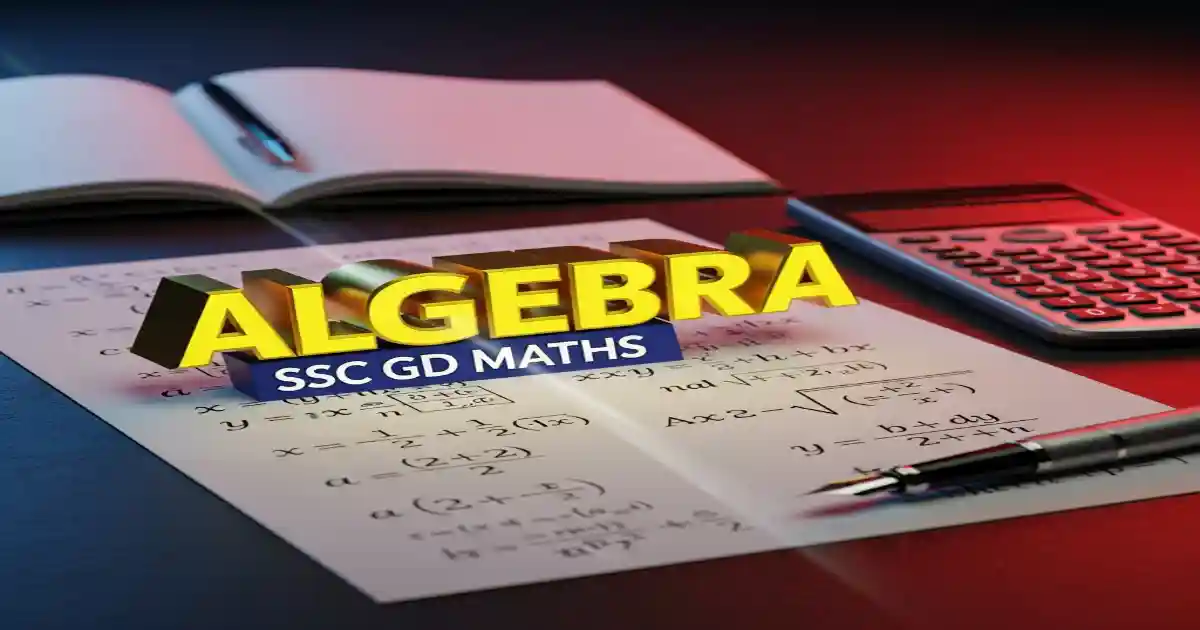
Introduction to SSC GD Algebra
Algebra is like a puzzle game where we use letters (like
- In algebra, we learn how to find the missing value.
- This topic is very important for the SSC GD Constable 2026 exam.
- We will keep the rules very simple so you can master SSC GD Algebra easily.
Simple Algebraic Expressions
What are Variables and Constants?
An expression is a mix of numbers and letters.
- Variables: These are the letters (
- Constants: These are the plain numbers (5, 10, 100). Their value never changes.
- Example: In the expression
Adding and Subtracting Expressions
We can only add or subtract things that are the same.
- Think of it like fruits: You can add 3 apples (
- You cannot add 3 apples (
- This rule is key to solving problems in SSC GD Algebra.
4 Solved Examples
Example 1: Find the value of
Solution:
- First, let’s understand that all these terms have the same variable (
- We can just add and subtract the numbers in front of
- We start with
- Now we take the result and subtract 2.
- So, the answer is
Example 2: Simplify the expression
Solution:
- First, let’s group the terms that are the same. Group the ‘a’ terms and the ‘b’ terms.
- ‘a’ terms:
- ‘b’ terms:
- ‘a’ terms:
- Now, let’s solve the ‘a’ terms first.
- Next, solve the ‘b’ terms.
- We cannot add
- So, the answer is
Example 3: If
Solution:
- First, let’s understand that we need to replace the letter
- The expression
- Now, put the numbers in the expression:
- Calculate the multiplication first (BODMAS rule).
- So, the answer is 18. This is a common type of question in SSC GD Algebra.
Example 4: Multiply the expression
Solution:
- First, let’s understand that the number outside the bracket (3) must multiply everything inside the bracket.
- Multiply 3 by
- Multiply 3 by 5:
- Now, put the results together with the plus sign.
- So, the answer is
Linear Equations (One Variable)
The Balance Rule
A linear equation is like a balance scale. The equals sign (
- Example:
- The main goal in SSC GD Algebra equations is to get the variable (
Solving for X
When you move a number across the equals sign, you must change its sign (the opposite operation).
| Operation on Left | Operation on Right |
|---|---|
4 Solved Examples
Example 1: Solve for
Solution:
- First, we want to get
- When
- Now, calculate the subtraction.
- So, the answer is
Example 2: Solve for
Solution:
- First, remember that
- To get
- Now, calculate the division.
- So, the answer is
Example 3: Solve for
Solution:
- First, we move the number that is being added or subtracted. Move
- Calculate the right side.
- Now,
- Calculate the division.
- So, the answer is
Example 4: Solve for
Solution:
- First, move the
- Calculate the right side.
- Now, 2 is dividing
- Calculate the multiplication.
- So, the answer is
Basic Algebraic Identities (Shortcuts)
Identities are special formulas that are always true, no matter what numbers
Identity 1: The Plus Shortcut
This identity is used when you multiply
- Formula:
- Remember: Square the first term (
Identity 2: The Minus Shortcut
This identity is used when you multiply
- Formula:
- The only difference from the plus shortcut is the middle term: it is minus
Identity 3: The Difference Shortcut
This identity is used when you multiply
- Formula:
- This is the fastest shortcut! If you see two squares subtracted, you just add the terms once and subtract them once, and then multiply the results. This is very useful in SSC GD Algebra.
4 Solved Examples
Example 1: Expand
Solution:
- First, identify
- Use the formula
- Substitute
- Calculate each part:
- So, the answer is
Example 2: Expand
Solution:
- First, identify
- Use the formula
- Substitute
- Calculate each part carefully:
- So, the answer is
Example 3: Calculate
Solution:
- First, we can write 101 as a sum of easy numbers:
- So, we need to calculate
- Use the formula
- Substitute the numbers:
- Calculate each part:
- Add them up:
- So, the answer is 10201. This shows how SSC GD Algebra shortcuts work.
Example 4: Calculate
Solution:
- First, this looks like
- Use the formula
- Substitute the numbers into the brackets:
- Solve the first bracket:
- Solve the second bracket:
- Multiply the results:
- So, the answer is 200. This is a fast way to solve SSC GD Algebra problems involving squares.