
- Introduction to 3D Shapes
- Understanding Volume and Surface Area
- Cube
- Cuboid
- Cylinder
- Basic Cone and Sphere
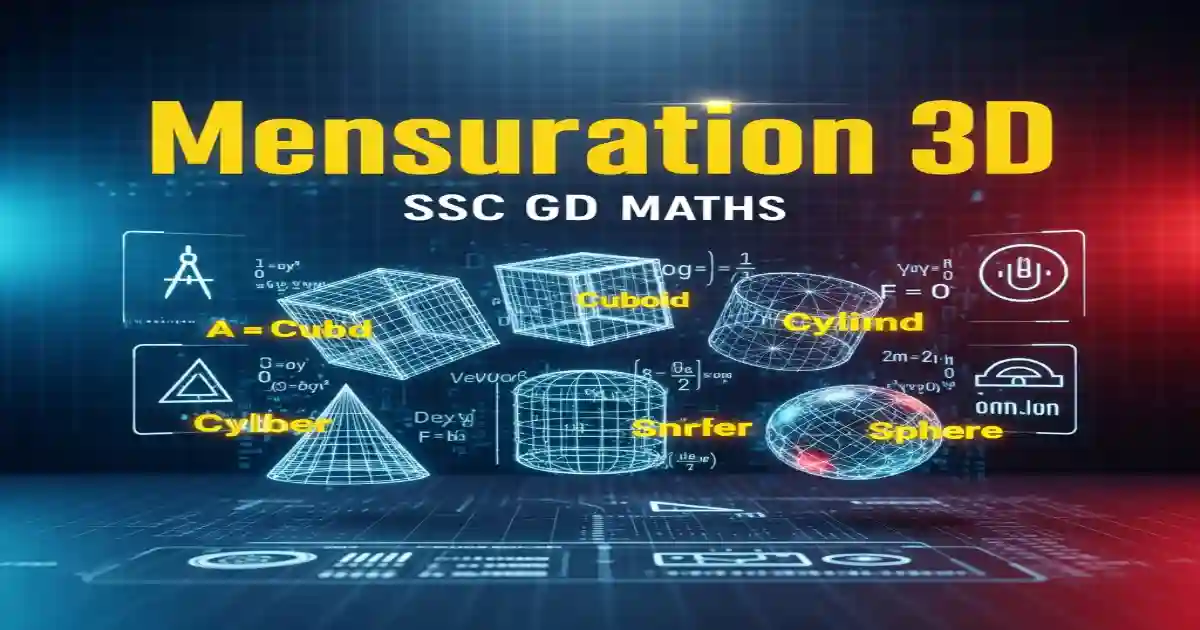
Introduction to 3D Shapes
Welcome to your study notes for ssc gd mensuration! We are going to learn about 3D shapes.
What is a 3D shape?
- 3D means “Three Dimensions.”
- It means the shape has length, width, and height.
- These shapes are solid, like a ball or a box.
- 2D shapes (like squares) are flat, but 3D shapes take up space in the real world.
- Learning these concepts is key to solving ssc gd mensuration questions.
Understanding Volume and Surface Area
When we study 3D shapes for mensuration ssc gd, we look for two main things: Volume and Surface Area.
Volume (How much fits inside?)
- Volume tells us how much space is inside the shape.
- Imagine you have a big water tank. The volume is how much water the tank can hold.
- Volume is always measured in cubic units (like
Surface Area (How much paint is needed?)
- Surface Area tells us the total area of all the outside faces (sides) of the shape.
- Imagine you want to paint a box. The surface area is the total amount of paint you need to cover the entire box.
- Surface Area is always measured in square units (like
Cube
A Cube is a very special 3D shape. Think of a standard dice or a sugar cube.
- All the sides (faces) of a cube are squares.
- All the edges (length, width, and height) are exactly the same size. We call this size ‘a’.
- Understanding the cube is essential for solving basic ssc gd mensuration questions formula.
Formulas for Cube
| Measurement | Formula (where ‘a’ is the side length) |
|---|---|
| Volume (V) | |
| Total Surface Area (TSA) | |
| Lateral Surface Area (LSA) |
4 Solved Examples (Cube)
Example 1: Finding Volume
A cube has a side length of 5 cm. What is its Volume? This is a common type of ssc gd mensuration question.
Solution:
- First, let’s understand what we need to find. We need the Volume (how much space is inside).
- Now, write down the formula for Volume of a Cube:
- Put the numbers in. The side length (
- Calculate it.
- So, the answer is
Example 2: Finding Total Surface Area
If the side of a cube is 10 meters, what is the Total Surface Area (TSA)?
Solution:
- First, we need the Total Surface Area (the area of all 6 sides).
- Now, write down the formula for TSA:
- Put the numbers in. The side length (
- Calculate the square first:
- Calculate the final area:
- So, the answer is
Example 3: Finding Lateral Surface Area
A room is shaped like a cube with a side of 4 meters. We only want to paint the four walls (LSA). How much area needs painting? This helps practice mensuration ssc gd questions formula.
Solution:
- We need the Lateral Surface Area (LSA), which means the 4 walls only.
- Write down the formula for LSA:
- Put the numbers in. The side length (
- Calculate the square:
- Calculate the final area:
- So, the answer is
Example 4: Finding Side from Volume
The volume of a cube is
Solution:
- We know the Volume (
- We need to find the number (
- We need to find the cube root of 27.
- So, the side length (
- The answer is 3 cm.
Cuboid
A Cuboid is like a stretched cube. Think of a matchbox, a book, or a standard brick.
- A Cuboid has 6 faces, but they are rectangles, not necessarily squares.
- It has three different measurements: Length (
- These mensuration ssc gd questions often involve packing or storage.
Formulas for Cuboid
| Measurement | Formula |
|---|---|
| Volume (V) | |
| Total Surface Area (TSA) | |
| Lateral Surface Area (LSA) |
4 Solved Examples (Cuboid)
Example 1: Finding Volume
A box has a length of 8 cm, a breadth of 3 cm, and a height of 2 cm. Find the volume of the box.
Solution:
- We need the Volume (V), which is how much the box holds.
- Write down the formula:
- Put the numbers in:
- Calculate it:
- So, the answer is
Example 2: Finding Total Surface Area
Calculate the Total Surface Area (TSA) of a cuboid with
Solution:
- We need the Total Surface Area (TSA) of all 6 faces.
- Write down the formula:
- Calculate the three parts inside the bracket first:
- Add them up:
- Calculate the final area:
- So, the answer is
Example 3: Finding Height from Volume
A water tank has a volume of
Solution:
- We know the Volume (
- Put the known numbers into the formula:
- Multiply the length and breadth:
- To find
- Calculate it:
- So, the height is 2 meters.
Example 4: Finding Lateral Surface Area
A hall has dimensions
Solution:
- First, find the Lateral Surface Area (LSA) of the four walls.
Formula:
- Put the numbers in:
- Calculate the bracket first:
- Now, find the total cost. Cost = Area
- Calculate the cost: Cost = ₹400
- The total cost of painting is ₹400.
Cylinder
A Cylinder is a shape like a soda can, a pipe, or a drum.
- It has two flat circular bases (top and bottom).
- It has one curved surface connecting the bases.
- We use the radius (
- Remember that
Formulas for Cylinder
| Measurement | Formula |
|---|---|
| Volume (V) | |
| Curved Surface Area (CSA) | |
| Total Surface Area (TSA) |
4 Solved Examples (Cylinder)
Example 1: Finding Volume
A cylindrical pipe has a radius (
Solution:
- We need the Volume (V).
- Write down the formula:
- Put the numbers in:
- Simplify the calculation:
- Calculate it:
- The volume is
Example 2: Finding Curved Surface Area
A cylindrical pillar has a radius of 1 meter and a height of 5 meters. Find the Curved Surface Area (CSA). (Use
Solution:
- We need the Curved Surface Area (CSA), the area of the side.
- Write down the formula:
- Put the numbers in:
- Multiply the simple numbers first:
- Calculate it:
- The CSA is
Example 3: Finding Total Surface Area
A closed drum has
Solution:
- We need the Total Surface Area (TSA).
Formula:
- Calculate the CSA part (
- Calculate the area of the two circles (
- Add the parts together:
- The TSA is
Example 4: Finding Height from Volume
The volume of a cylinder is
Solution:
- We know
- Put the known numbers in:
- Simplify the radius part:
- Multiply the constants:
- Solve for
- Divide (both numbers are divisible by 22):
- The height is
Basic Cone and Sphere
For the ssc gd mensuration syllabus, you need to know the basic formulas for cones and spheres.
Cone
A Cone is a shape like an ice cream cone or a birthday hat. It has a circular base and comes to a point (apex).
| Measurement | Formula |
|---|---|
| Volume (V) | |
| Curved Surface Area (CSA) |
Sphere
A Sphere is a perfectly round 3D object, like a football or a tennis ball. It only has a radius (
| Measurement | Formula |
|---|---|
| Volume (V) | |
| Surface Area (SA) |
4 Solved Examples (Cone and Sphere)
Example 1 (Cone Volume)
A cone has a radius of 3 cm and a height of 7 cm. Find its Volume. (Use
Solution:
- We need the Volume (V).
- Write down the formula:
- Put the numbers in:
- Simplify the calculation:
- Cancel out the 7s and simplify the 3:
- Calculate it:
- The volume is
Example 2 (Cone CSA)
A cone has a radius of 5 m and a slant height (
Solution:
- We need the Curved Surface Area (CSA).
- Write down the formula:
- Put the numbers in:
- Multiply the simple numbers first:
- Calculate it:
- The CSA is
Example 3 (Sphere Surface Area)
Find the Surface Area of a sphere with a radius of 7 meters. (Use
Solution:
- We need the Surface Area (SA).
- Write down the formula:
- Put the numbers in:
- Simplify the calculation:
- Calculate it:
- The Surface Area is
Example 4 (Sphere Volume)
Calculate the volume of a sphere if the radius is 3 cm. (Use
Solution:
- We need the Volume (V).
- Write down the formula:
- Put the numbers in:
- Calculate
- Substitute back:
- Simplify the fraction:
- Multiply the constants:
- Calculate the final volume:
- The volume is
- Introduction to 3D Shapes
- Understanding Volume and Surface Area
- Cube
- Cuboid
- Cylinder
- Basic Cone and Sphere
Introduction to 3D Shapes
Welcome to your study notes for ssc gd mensuration! We are going to learn about 3D shapes.
What is a 3D shape?
- 3D means “Three Dimensions.”
- It means the shape has length, width, and height.
- These shapes are solid, like a ball or a box.
- 2D shapes (like squares) are flat, but 3D shapes take up space in the real world.
- Learning these concepts is key to solving ssc gd mensuration questions.
Understanding Volume and Surface Area
When we study 3D shapes for mensuration ssc gd, we look for two main things: Volume and Surface Area.
Volume (How much fits inside?)
- Volume tells us how much space is inside the shape.
- Imagine you have a big water tank. The volume is how much water the tank can hold.
- Volume is always measured in cubic units (like
Surface Area (How much paint is needed?)
- Surface Area tells us the total area of all the outside faces (sides) of the shape.
- Imagine you want to paint a box. The surface area is the total amount of paint you need to cover the entire box.
- Surface Area is always measured in square units (like
Cube
A Cube is a very special 3D shape. Think of a standard dice or a sugar cube.
- All the sides (faces) of a cube are squares.
- All the edges (length, width, and height) are exactly the same size. We call this size ‘a’.
- Understanding the cube is essential for solving basic ssc gd mensuration questions formula.
Formulas for Cube
| Measurement | Formula (where ‘a’ is the side length) |
|---|---|
| Volume (V) | |
| Total Surface Area (TSA) | |
| Lateral Surface Area (LSA) |
4 Solved Examples (Cube)
Example 1: Finding Volume
A cube has a side length of 5 cm. What is its Volume? This is a common type of ssc gd mensuration question.
Solution:
- First, let’s understand what we need to find. We need the Volume (how much space is inside).
- Now, write down the formula for Volume of a Cube:
- Put the numbers in. The side length (
- Calculate it.
- So, the answer is
Example 2: Finding Total Surface Area
If the side of a cube is 10 meters, what is the Total Surface Area (TSA)?
Solution:
- First, we need the Total Surface Area (the area of all 6 sides).
- Now, write down the formula for TSA:
- Put the numbers in. The side length (
- Calculate the square first:
- Calculate the final area:
- So, the answer is
Example 3: Finding Lateral Surface Area
A room is shaped like a cube with a side of 4 meters. We only want to paint the four walls (LSA). How much area needs painting? This helps practice mensuration ssc gd questions formula.
Solution:
- We need the Lateral Surface Area (LSA), which means the 4 walls only.
- Write down the formula for LSA:
- Put the numbers in. The side length (
- Calculate the square:
- Calculate the final area:
- So, the answer is
Example 4: Finding Side from Volume
The volume of a cube is
Solution:
- We know the Volume (
- We need to find the number (
- We need to find the cube root of 27.
- So, the side length (
- The answer is 3 cm.
Cuboid
A Cuboid is like a stretched cube. Think of a matchbox, a book, or a standard brick.
- A Cuboid has 6 faces, but they are rectangles, not necessarily squares.
- It has three different measurements: Length (
- These mensuration ssc gd questions often involve packing or storage.
Formulas for Cuboid
| Measurement | Formula |
|---|---|
| Volume (V) | |
| Total Surface Area (TSA) | |
| Lateral Surface Area (LSA) |
4 Solved Examples (Cuboid)
Example 1: Finding Volume
A box has a length of 8 cm, a breadth of 3 cm, and a height of 2 cm. Find the volume of the box.
Solution:
- We need the Volume (V), which is how much the box holds.
- Write down the formula:
- Put the numbers in:
- Calculate it:
- So, the answer is
Example 2: Finding Total Surface Area
Calculate the Total Surface Area (TSA) of a cuboid with
Solution:
- We need the Total Surface Area (TSA) of all 6 faces.
- Write down the formula:
- Calculate the three parts inside the bracket first:
- Add them up:
- Calculate the final area:
- So, the answer is
Example 3: Finding Height from Volume
A water tank has a volume of
Solution:
- We know the Volume (
- Put the known numbers into the formula:
- Multiply the length and breadth:
- To find
- Calculate it:
- So, the height is 2 meters.
Example 4: Finding Lateral Surface Area
A hall has dimensions
Solution:
- First, find the Lateral Surface Area (LSA) of the four walls.
Formula:
- Put the numbers in:
- Calculate the bracket first:
- Now, find the total cost. Cost = Area
- Calculate the cost: Cost = ₹400
- The total cost of painting is ₹400.
Cylinder
A Cylinder is a shape like a soda can, a pipe, or a drum.
- It has two flat circular bases (top and bottom).
- It has one curved surface connecting the bases.
- We use the radius (
- Remember that
Formulas for Cylinder
| Measurement | Formula |
|---|---|
| Volume (V) | |
| Curved Surface Area (CSA) | |
| Total Surface Area (TSA) |
4 Solved Examples (Cylinder)
Example 1: Finding Volume
A cylindrical pipe has a radius (
Solution:
- We need the Volume (V).
- Write down the formula:
- Put the numbers in:
- Simplify the calculation:
- Calculate it:
- The volume is
Example 2: Finding Curved Surface Area
A cylindrical pillar has a radius of 1 meter and a height of 5 meters. Find the Curved Surface Area (CSA). (Use
Solution:
- We need the Curved Surface Area (CSA), the area of the side.
- Write down the formula:
- Put the numbers in:
- Multiply the simple numbers first:
- Calculate it:
- The CSA is
Example 3: Finding Total Surface Area
A closed drum has
Solution:
- We need the Total Surface Area (TSA).
Formula:
- Calculate the CSA part (
- Calculate the area of the two circles (
- Add the parts together:
- The TSA is
Example 4: Finding Height from Volume
The volume of a cylinder is
Solution:
- We know
- Put the known numbers in:
- Simplify the radius part:
- Multiply the constants:
- Solve for
- Divide (both numbers are divisible by 22):
- The height is
Basic Cone and Sphere
For the ssc gd mensuration syllabus, you need to know the basic formulas for cones and spheres.
Cone
A Cone is a shape like an ice cream cone or a birthday hat. It has a circular base and comes to a point (apex).
| Measurement | Formula |
|---|---|
| Volume (V) | |
| Curved Surface Area (CSA) |
Sphere
A Sphere is a perfectly round 3D object, like a football or a tennis ball. It only has a radius (
| Measurement | Formula |
|---|---|
| Volume (V) | |
| Surface Area (SA) |
4 Solved Examples (Cone and Sphere)
Example 1 (Cone Volume)
A cone has a radius of 3 cm and a height of 7 cm. Find its Volume. (Use
Solution:
- We need the Volume (V).
- Write down the formula:
- Put the numbers in:
- Simplify the calculation:
- Cancel out the 7s and simplify the 3:
- Calculate it:
- The volume is
Example 2 (Cone CSA)
A cone has a radius of 5 m and a slant height (
Solution:
- We need the Curved Surface Area (CSA).
- Write down the formula:
- Put the numbers in:
- Multiply the simple numbers first:
- Calculate it:
- The CSA is
Example 3 (Sphere Surface Area)
Find the Surface Area of a sphere with a radius of 7 meters. (Use
Solution:
- We need the Surface Area (SA).
- Write down the formula:
- Put the numbers in:
- Simplify the calculation:
- Calculate it:
- The Surface Area is
Example 4 (Sphere Volume)
Calculate the volume of a sphere if the radius is 3 cm. (Use
Solution:
- We need the Volume (V).
- Write down the formula:
- Put the numbers in:
- Calculate
- Substitute back:
- Simplify the fraction:
- Multiply the constants:
- Calculate the final volume:
- The volume is