
- Introduction to Trigonometry
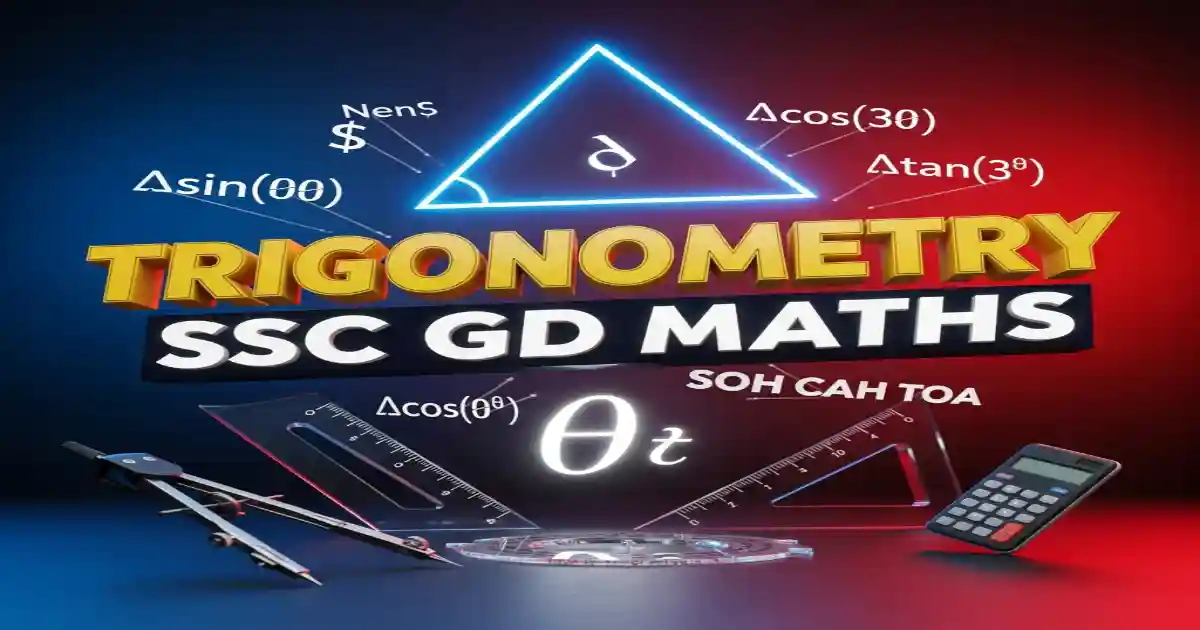
- Understanding Trigonometric Ratios (SOH CAH TOA)
- Standard Values (0°, 30°, 45°, 60°, 90°)
- Simple Trigonometric Identities
Introduction to Trigonometry
Trigonometry is a big word, but it just means measuring triangles.
Imagine you are standing far away from a tall building. You want to know how high the building is, but you cannot climb it with a measuring tape.
- Trigonometry helps us find the height using angles and distances on the ground.
- It only works with right-angled triangles (triangles that have one
- Learning these basic rules is key to solving ssc gd trigonometry questions quickly.
Understanding Trigonometric Ratios (SOH CAH TOA)
In a right-angled triangle, we give special names to the three sides based on the angle (
- Hypotenuse (H): This is the longest side. It is always opposite the
- Opposite (O): This side is opposite the angle (
- Adjacent (A): This side is next to the angle (
The Six Ratios
We use three main ratios (fractions) to connect the sides and the angle. We remember them using the simple phrase: SOH CAH TOA.
| Ratio Name | Short Form | Formula (SOH CAH TOA) | Reciprocal (Flip) |
|---|---|---|---|
| Sine | |||
| Cosine | |||
| Tangent |
Key Relationships to Remember:
Solved Examples for Ratios
These types of ssc gd trigonometry questions test your understanding of the basic side ratios.
Example 1: Finding Sine and Cosine
In a right-angled triangle, the Opposite side is 3 cm and the Hypotenuse is 5 cm. Find the value of
Solution:
- First, let’s understand what we need to find. We need
- Now, remember the SOH rule:
- Put the numbers in. Opposite
- Calculate it.
- So, the answer is
Example 2: Finding Tangent
If the Adjacent side is 12 and the Opposite side is 5, what is
Solution:
- We need
- The formula is:
- Put the numbers in. Opposite
- Since 5 and 12 cannot be simplified, this is our final answer.
- So, the answer is
Example 3: Using Reciprocals
If
Solution:
- First, we remember the relationship between
- The formula is:
- Now, write down the value of
- To find
- So, the answer is
Example 4: Finding Sine when Cosine is Known
If
Solution:
- We know
- We need
- Use Pythagoras Theorem:
- Calculate the squares:
- Now find
- So, the answer is
Standard Values (0°, 30°, 45°, 60°, 90°)
In SSC GD exams, you must know the values of the ratios for certain special angles by heart. These are the most common ssc gd trigonometry questions asked.
The Important Value Table
You must memorize this table. It is the foundation for solving many problems.
| 0 | 1 | ||||
| 1 | 0 | ||||
| 0 | 1 | Undefined |
- Tip: If you know the
- Tip:
Solved Examples using Standard Values
These examples show how to use the table to solve ssc gd trigonometry questions.
Example 1: Simple Addition
Find the value of
Solution:
- First, we look up the values in our table.
- Now, we put these numbers into the equation.
- We add the fractions. Half plus half equals one whole.
- So, the answer is 1.
Example 2: Multiplication
Calculate
Solution:
- First, find the values from the table.
- Now, substitute the values into the expression.
- Do the multiplication first (BODMAS rule).
- Calculate the final sum.
- So, the answer is 3.
Example 3: Using Square Roots
Find the value of
Solution:
- First, find the values for
- Now, we need to square these values. Remember,
- Substitute the squared values back into the equation.
- Add the fractions.
- Simplify the fraction by dividing the top and bottom by 2.
Example 4: Using Reciprocals and Division
Calculate
Solution:
- First, find the values from the table.
- Now, substitute the values into the fraction.
- When the top number (numerator) and the bottom number (denominator) are exactly the same, the answer is 1.
- So, the answer is 1. These are typical ssc gd trigonometry questions that look hard but are easy if you know the table.
Simple Trigonometric Identities
Identities are like special math rules that are always true, no matter what angle (
The Three Main Rules
These rules involve squaring the ratios.
Rule 1 (The most important):
- Simple Meaning: If you square the sine of an angle and add it to the square of the cosine of the same angle, the answer is always 1.
Rule 2:
- Simple Meaning: This rule connects tangent and secant.
Rule 3:
- Simple Meaning: This rule connects cotangent and cosecant.
Solved Examples using Identities
Example 1: Using Rule 1 Directly
Simplify the expression:
Solution:
- First, notice that the angle (
- We can take the number 5 out (factor it).
- Now, we use Identity Rule 1:
- Calculate the final value.
- So, the answer is 5.
Example 2: Using Rule 2
If
Solution:
- First, we look for the rule that connects
- We are given
- Now, put the number 9 into the formula.
- Calculate the final sum.
- So, the answer is 10.
Example 3: Rearranging Rule 1
Simplify:
Solution:
- This looks tricky, but we start with Rule 1:
- We want to find what
- Now, we apply this to the question (
- So, the simplified expression is
Example 4: Using Rule 3
Simplify the expression:
Solution:
- First, we look at Rule 3, which connects
- We want to find
- Since the expression we needed to simplify is exactly the same as the right side of our rearranged formula, the answer is 1.
- So, the answer is 1.