- Hey there! Before you dive into the full article, here is a quick and simple overview of what we are going to cover today:
- First, we'll explore introduction.
- We will also deep dive into why do we study this? (real life examples).
- You'll learn some interesting facts about simplest definition.
- Make sure not to miss the part where we discuss key formula box.
- First, we'll explore detailed derivation (step-by-step for exams).
- We will also deep dive into step-by-step derivation.
- You'll learn some interesting facts about important table.

Introduction
Hello students! Today we are going to learn about Position vector in Cartesian Coordinate. Don't worry if it looks hard, we will make it very simple.
See, the Position Vector is one of the most fundamental concepts in Physics. It is simply a vector that tells us the location, or the position, of any particle or object with respect to a fixed reference point, which we usually call the Origin (
Why do we study this? (Real Life Examples)
Now, why should we study this concept? This is not just theoretical derivation, students. This is essential for understanding motion.
Missile Guidance System: For example, when the Army launches a missile, they must know the exact location of the target relative to the launch point. If the target is
km km km Using GPS in Mobile Phones: Have you noticed how your mobile phone shows your location on Google Maps? The satellites orbiting the Earth constantly communicate coordinates (
Robotics in Factories: When a robot arm in a car manufacturing plant needs to pick up a specific component, the robot’s programming relies entirely on knowing the exact position vector of the component and the destination position vector where it needs to place it. These coordinates are fed as inputs to the robot’s control system.
Simplest Definition
Definition:
The Position Vector (
Diagram
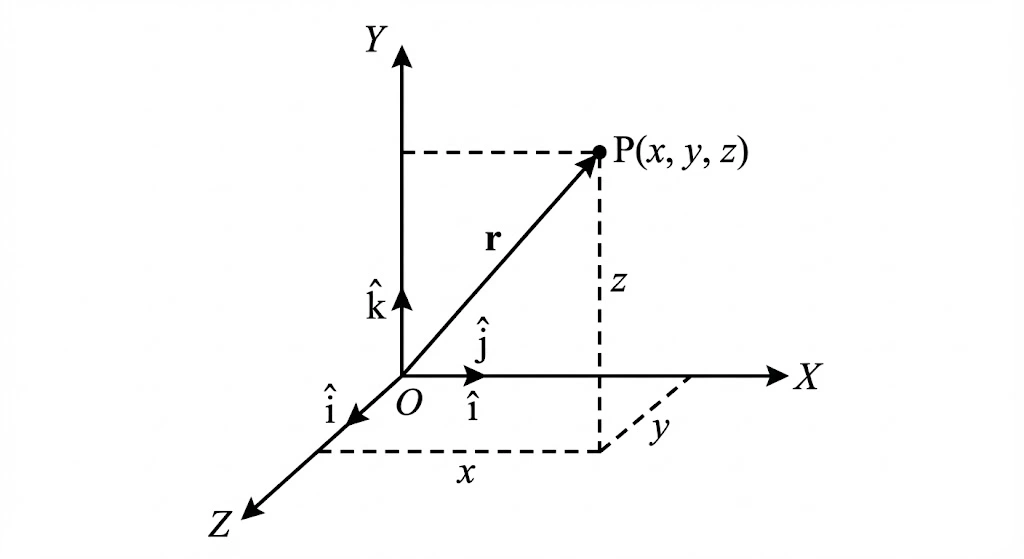
Figure: Detailed description of diagram for Position vector in Cartesian Coordinate: A 3D coordinate system (X, Y, Z axes) originating at O. A point P(x, y, z) is shown in the first octant. A vector
Key Formula Box
We use the unit vectors
Detailed Derivation (Step-by-Step for Exams)
This derivation is very important. It is often asked in 5-mark questions. You must show all the steps properly.
Step-by-Step Derivation
Let us consider a particle situated at point
Let the coordinates of the point
The vector
Step 1: Defining Components
The coordinates
We define the following component vectors:
The component vector along the
...(1) The component vector along the
...(2) The component vector along the
...(3)
Step 2: Applying Vector Addition (Polygon Law)
The total position vector
According to the Polygon Law of Vector Addition, the resultant vector is the vector sum of its components:
Step 3: Final Form of Position Vector
Now, let us substitute the component definitions from equations (1), (2), and (3) into the vector sum equation:
Thus, the Position Vector
Step 4: Derivation of Magnitude of the Position Vector (
The magnitude of the position vector, denoted by
We can find this magnitude by applying the Pythagorean Theorem twice in the 3D space.
First, consider the components in the
Now, consider the right-angled triangle formed by
We substitute the value of
Taking the square root on both sides, we get the magnitude:
Important Table
Here is a summary of the fundamental components we used in the derivation. This table will help you clarify the role of unit vectors.
| Vector Symbol | Name | Along Axis | Magnitude ( | Role |
|---|---|---|---|---|
| Position Vector | Locates the particle. | |||
| Unit Vector | Positive X | Provides direction along X-axis. | ||
| Unit Vector | Positive Y | Provides direction along Y-axis. | ||
| Unit Vector | Positive Z | Provides direction along Z-axis. |
Solved Numericals (Exam Style)
Let us solve a few problems based on this concept. You must write the steps clearly, just like shown below.
Solved Numericals (Exam Style)
Q1: A particle is located at point
Ans:
Given:
Coordinates of the particle
To Find:
Position vector
Formula:
Calculation:
We substitute the given values directly into the formula.
Final Answer with units:
The position vector is
Q2: Find the magnitude of the position vector
Ans:
Given:
Position vector
To Find:
Magnitude of the position vector,
Formula:
Calculation:
We substitute the values:
Final Answer with units:
The magnitude of the position vector is
Q3: A particle moves from point
Ans:
Given:
Initial position vector
To Find:
Displacement vector
Formula:
Displacement vector is the change in position:
Calculation:
Final Answer with units:
The displacement vector is
Exam Corner: Questions & Answers
Short Answer Questions (2 Marks Each)
Q: What is the physical significance of the origin (
Ans: The origin (
Q: Write the difference between a position vector and a displacement vector.
Ans:
The Position Vector (
Q: If the position vector of a particle is
Ans:
- Coordinates: Comparing the vector with the general form
- Distance from Origin (Magnitude):
units.
Long Answer Questions (5 Marks Each)
Q: Explain the position vector in Cartesian coordinates. Derive the mathematical expression for the position vector and its magnitude in three dimensions.
Ans:
Position Vector in Cartesian Coordinates
The position vector
Derivation of Position Vector (
- Setup: Let
- Components: The vector
- Expression for Components: Since unit vectors give direction, the component vectors are written as:
- Vector Addition: Using the law of vector addition (specifically, the Polygon Law), the position vector is the sum of its components:
- Final Position Vector: Substituting the components:
Derivation of Magnitude (
The magnitude
- XY Plane Distance (
...(1) - 3D Distance: Now, considering the right triangle formed by
- Substitution: Substituting Eq. (1) into the expression:
- Final Magnitude: Taking the square root gives the magnitude:
Multiple Choice Questions (MCQs)
Q1: The position vector of a particle is given by
Q2: The direction of the unit vector
Q3: If a particle is located exactly on the Y-axis at
Q4: A displacement from point
Q5: Which of the following defines the unit vector in the direction of position vector
Summary
I hope this concept is clear now. See, the position vector is just a tool to specify location in space using a fixed reference point (the origin). We found that in Cartesian coordinates, the vector is simply
This understanding is essential for the next topics, especially velocity and acceleration vectors. Practice the derivation twice and work out the solved numericals on your own. All the best for your exams!
For more notes visit on universityscope.com .. Notes are complete for college exam and according to university