- Hey there! Before you dive into the full article, here is a quick and simple overview of what we are going to cover today:
- First, we'll explore unit vector.
- We will also deep dive into why do we study this? (real life examples).
- You'll learn some interesting facts about simplest definition.
- Make sure not to miss the part where we discuss key formula box.
- First, we'll explore detailed derivation (step-by-step for exams).
- We will also deep dive into step-by-step derivation.

Unit Vector
Hello students! Today we are going to learn about Unit vector. Don't worry if it looks hard, we will make it very simple.
See, vectors are essential in Physics because they tell us both how much (magnitude) and in which way (direction) something is happening. The Unit Vector is very special because it only cares about the direction. It is a mathematical tool we use to specify a direction clearly, without confusing it with the actual size or magnitude of the physical quantity.
Why do we study this? (Real Life Examples)
Now, why is this topic important for us? You must always ask: Where do I see this in real life? The study of the Unit vector is fundamental because direction matters in everything we do.
- Satellite Dish Positioning: Have you seen the small dish antenna on your roof? It must be pointed exactly towards the satellite in space. The magnitude (the size of the dish) is fixed, but if the direction changes by even a tiny bit, you lose the signal. The exact pointing direction is defined using a unit vector.
- The Ceiling Fan: When the fan is rotating, the axis of rotation is defined by a vector. We might ask, "Is the fan rotating clockwise or counter-clockwise?" To specify this rotation's direction (using the right-hand rule), we use a unit vector along the axis. The actual speed (magnitude) is separate from the axis direction.
- GPS Navigation: When you use Google Maps, it tells you to move
Simplest Definition
Definition: A Unit vector is a vector that has a magnitude (or length) of exactly one (unity) and is used solely to indicate the direction of a given vector.
The Unit vector of any vector
Diagram
`
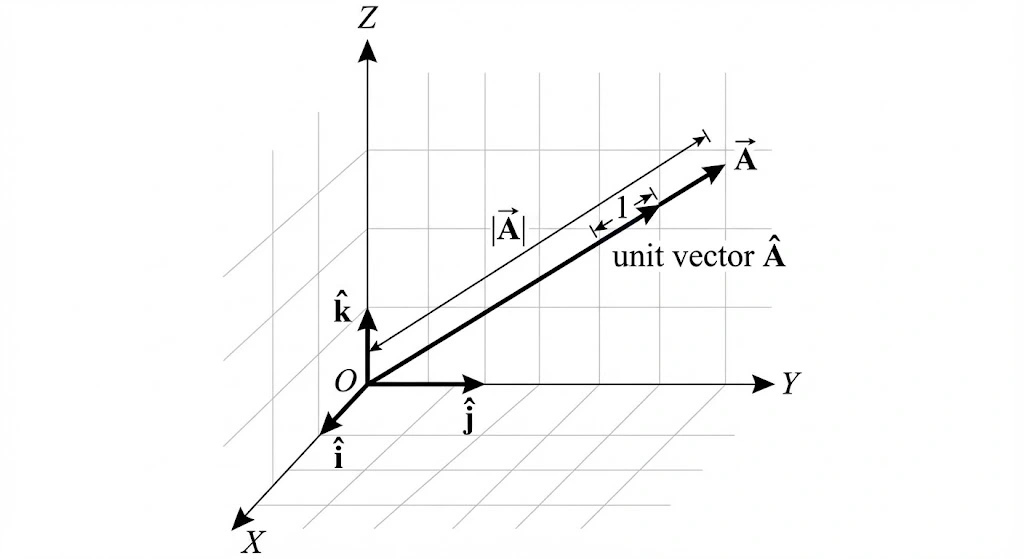
Figure: A line segment representing the vector A (
`
Key Formula Box
This formula is very important. You must remember this for numerical problems.
Here,
Detailed Derivation (Step-by-Step for Exams)
Step-by-Step Derivation
This derivation is often asked in 5-mark questions. Pay attention to every step.
Step 1: Defining the General Vector
See, the logic is very simple. Any vector, let's call it
- Its actual length or size (Magnitude).
- The direction in which it points (Unit vector).
So, mathematically, we write this fundamental relationship:
We use the standard symbols:
Step 2: Isolating the Unit Vector
Our goal is to find the expression for the Unit vector
We want to keep
Since
This is the main formula for the Unit Vector.
Step 3: Expression in Cartesian Coordinates
Now, let us make this more practical for calculations. Suppose our vector
The vector
Step 4: Calculating the Magnitude
To use Equation (2), we need the magnitude
Step 5: Final Comprehensive Expression
Finally, we substitute the expressions for
This complete expression is the one you will use for all exam calculations. You must write this final step clearly.
Important Table
| Feature | Standard Vector ( | Unit Vector ( |
|---|---|---|
| Purpose | Defines both magnitude and direction. | Defines only direction. |
| Magnitude | Can be any positive number. | Always 1 (unity). |
| Notation | Arrow above ( | Cap/Hat above ( |
| Formula |
Standard Unit Vectors in Cartesian Coordinates:
| Axis | Vector | Components |
|---|---|---|
| X-axis | ||
| Y-axis | ||
| Z-axis | ||
| Magnitude Check |
Solved Numericals (Exam Style)
You must practice these types of problems. They usually come for 3 marks.
Q1: Find the unit vector in the direction of
Ans:
Given: Vector
Calculation:
Step 1: Calculate the magnitude
Step 2: Substitute magnitude and vector into the formula.
Step 3: Simplify (This is good practice for the final answer).
Final Answer with units: The unit vector is
Q2: A vector
Ans:
Given: Magnitude of
Calculation:
Step 1: Find the unit vector
Now, find the unit vector
Step 2: Calculate the vector
Final Answer with units: The vector is
Q3: Given two vectors
Ans:
Given:
Calculation:
Step 1: Calculate the resultant vector
Step 2: Calculate the magnitude of the resultant
Step 3: Find the unit vector
Final Answer with units: The unit vector parallel to the resultant is
Exam Corner: Questions & Answers
Short Answer Questions (2 Marks Each)
Q: State two main properties of a Unit Vector.
Ans:
- Magnitude is Unity: The magnitude (or modulus) of any unit vector is always exactly equal to one (
- Direction Specification: Its sole purpose is to indicate the precise direction of the original vector in space. It is a dimensionless quantity, meaning it does not carry units.
Q: What is the significance of the expression
Ans:
The expression
Q: Express the direction cosines of a vector
Ans:
Let the vector be
Long Answer Questions (5 Marks Each)
Q: Define Unit Vector. Derive the complete expression for the unit vector
Ans:
Definition: A Unit vector is a vector whose magnitude is one (unity) and which is used purely to indicate the direction of a vector quantity. It is denoted by a cap (
Complete Derivation:
Step 1: Basic Vector Relationship
A vector
Step 2: Unit Vector Formula
Rearranging Eq (1) to isolate the unit vector:
Step 3: Component Representation of Vector
Step 4: Calculation of Magnitude
Step 5: Final Unit Vector Expression
Substitute the full expressions for
This expression successfully defines the unit vector purely in terms of the components of the original vector.
Multiple Choice Questions (MCQs)
Q1: The magnitude of any unit vector is always: A) Dependent on the coordinate system B) Zero C) Infinity D) One
Ans: D) - The definition of a unit vector is that its magnitude is unity (one).
Q2: If
Ans: B) - The magnitude of any unit vector, regardless of the components of the original vector, is always 1.
Q3: The unit vector along the negative z-axis is represented by:
A)
Ans: B) - The standard unit vector along the positive z-axis is
Q4: A vector
Ans: B) - Since
Q5: If
Ans: C) - For
Summary
So, students, I hope this concept of the Unit vector is clear now. Remember, the Unit vector is like the compass that tells us where to go, separate from how far we have to travel. Its single most important property is that its magnitude is always one. Practice the derivation twice, and make sure you show all steps when calculating the magnitude for numerical problems. This topic is fundamental for understanding mechanics and electromagnetism later on! All the best!
For more notes visit on universityscope.com .. Notes are complete for college exam and according to university