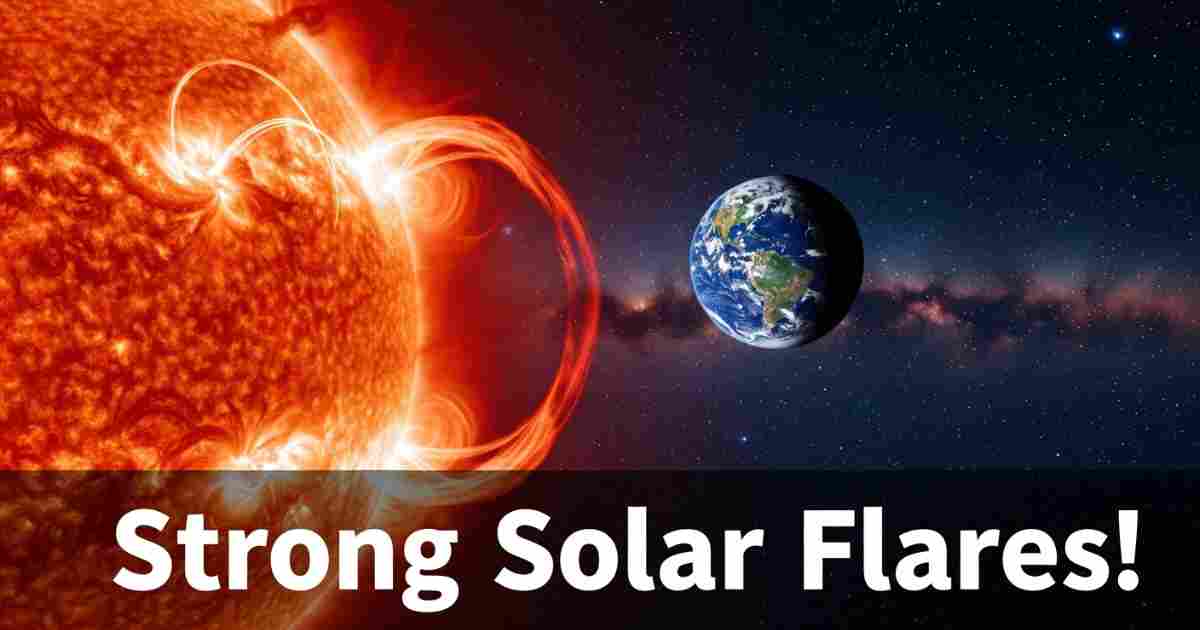

The Sun has released four strong solar flares, surprising space weather watchers around the world. These events were recorded on February 1 and February 2, 2026 by NASA’s Solar Dynamics Observatory, which constantly watches the Sun.
Solar flares are huge bursts of energy that shoot out from the Sun’s surface. They happen when magnetic energy near sunspots suddenly explodes into space.
Table of Contents
What Happened?
Between Feb. 1 and Feb. 2, the Sun gave off four major solar flares. These were measured as:
- X1.0 flare
- X8.1 flare
- X2.8 flare
- X1.6 flare
The “X” type means very strong solar flares. The number after the “X” shows how powerful the flare is — higher numbers mean more energy.
Scientists say one of these flares (the X8.1) was especially intense, releasing a lot of energy into space. This is part of the Sun’s current active phase known as Solar Cycle 25.
What Are Solar Flares?
A solar flare is like a giant explosion on the Sun’s surface. It releases energy, light, and radiation into space in just a few minutes. These flares happen near sunspots, where the Sun’s magnetic fields are very strong and twisted.
Solar flares belong to space weather — similar to storms on Earth, but happening in space.
Why Scientists Watch Solar Flares
Solar flares don’t hurt people on Earth because our atmosphere protects us. But they can affect technology and communication systems. Here’s how:
- Radio communications can become blocked or weak.
- GPS and navigation signals may become less accurate.
- Satellites can get disturbed by high-energy radiation.
- Astronauts in space face more radiation risk without Earth’s protection.
Scientists share solar flare data so the world can prepare for these changes and protect important systems.
How Often Do Solar Flares Happen?
Solar flares are not rare. They happen most often when the Sun is more active — usually during the middle of an 11-year cycle. Right now, the Sun is in a more active phase, so solar flares are being seen more often.
For example, earlier in January 2026 and late 2025, strong solar flares were also recorded by NASA’s space observatories.
Can Solar Flares Make Auroras?
Yes! When solar flares or related solar storms reach Earth, particles interact with Earth’s magnetic field and can make Northern Lights (aurora borealis) visible in the sky near the poles. Many scientists expect brighter auroras now because of these recent flares.
In Simple Words
The Sun has been very active and sent out very strong bursts of energy called solar flares. These events don’t harm people on Earth, but they can affect radio waves, GPS, satellites, and space missions. Scientists watch these solar flares closely so they can protect technology and give warnings when needed. For more visit university scope