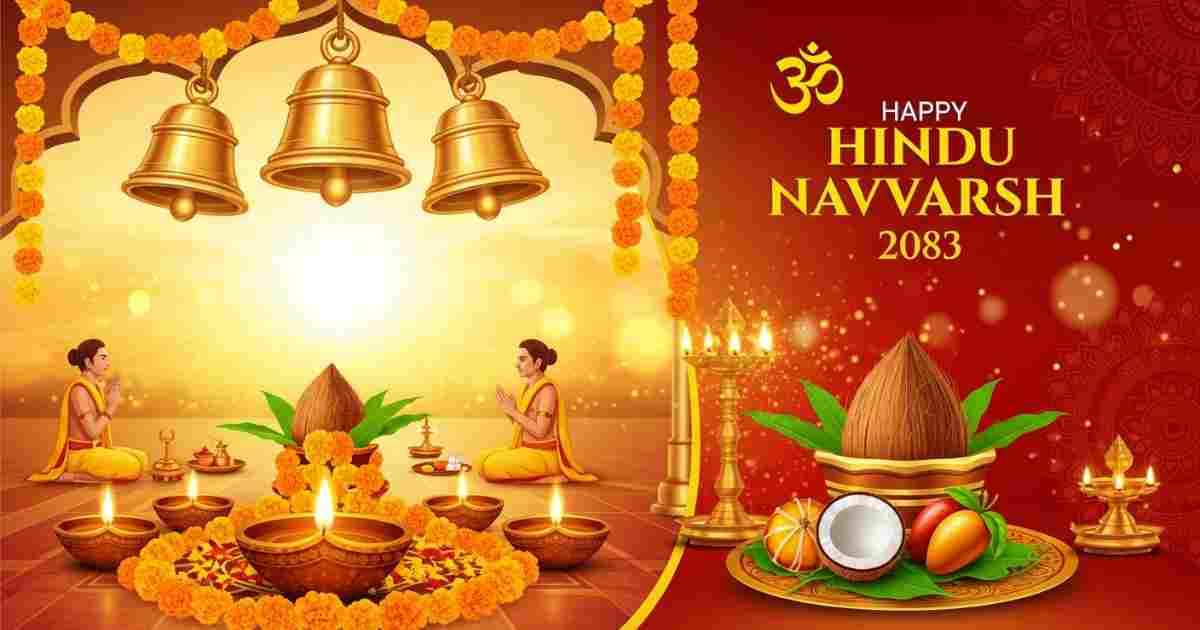

Hello, welcome to University Scope. I am Jagdeep Singh. Today, on this auspicious morning of 19 March 2026, I am thrilled to bring you the most comprehensive guide to Hindu Navvarsh 2083 – the sacred Hindu New Year that marks the beginning of Vikram Samvat 2083.
Whether you call it Hindu Navvarsh 2083, Hindu New Year 2026, Chaitra Navratri’s first day, or the dawn of Raudra Samvatsara, this is far more than just a date on the calendar. It is a cosmic invitation to renewal, wisdom, courage, and fresh beginnings aligned with ancient Vedic science.
In this depth article, we will explore everything about Hindu Navvarsh 2083 and the Hindu New Year: its complete history, the origin of the Hindu calendar, comparison with other Hindu calendars, exact starting details for 2026, step-by-step celebration guide, profound importance across spiritual, scientific, cultural, and economic dimensions, and why Hindu Navvarsh 2083 is especially powerful for students preparing for competitive exams and academic success.
Let us begin this enlightening journey into Hindu Navvarsh 2083 – the Hindu New Year that unites millions across India and the world.
Table of Contents
What Exactly Is Hindu Navvarsh 2083? The Hindu New Year Explained
Hindu Navvarsh 2083, also known as the Hindu New Year 2026, is the first day of Vikram Samvat 2083. It falls on Chaitra Shukla Pratipada – the first tithi of the bright lunar fortnight in the month of Chaitra.
This year, Hindu Navvarsh 2083 begins precisely on 19 March 2026, Thursday (Guruvar) at 6:52 AM. The tithi remains active throughout the day, making it the perfect moment for new beginnings.
What makes Hindu Navvarsh 2083 and this Hindu New Year truly special?
- Samvatsara name: Raudra Samvatsara (the 28th in the 60-year Vedic cycle, symbolising courage, patience, and transformative energy derived from Lord Rudra).
- King of the Year: Brihaspati (Jupiter) – the planet of wisdom, dharma, prosperity, and higher knowledge.
- Minister of the Year: Mangal (Mars) – the planet of courage, strength, and decisive action.
- Total months in the year: 13 (thanks to the extra Adhik Maas).
- Adhik Maas period: Adhik Jyeshtha from 17 May to 15 June 2026.
- Equivalent in India’s official Shaka Samvat: 1948.
The 57-year difference between Vikram Samvat and the Gregorian calendar exists because Hindu Navvarsh 2083 follows precise astronomical calculations rooted in the Vedas, while the Gregorian system is a later solar reform. This makes Hindu Navvarsh 2083 and the Hindu New Year a living bridge to our ancient scientific heritage.
Across India, this same day is celebrated under different regional names – Gudi Padwa in Maharashtra, Ugadi in Andhra Pradesh and Telangana, Yugadi in Karnataka, Navreh in Kashmir, and simply Hindu New Year or Nav Samvatsar in North India. Yet the essence remains identical: a celebration of cosmic renewal.
The Complete History of the Hindu Calendar – A Masterpiece of Vedic Astronomy
The Hindu calendar, known as Panchang, is one of humanity’s oldest and most sophisticated timekeeping systems. It is lunisolar, harmonising the moon’s cycle of approximately 29.53 days with the sun’s annual journey of 365.24 days. This brilliant design ensures that festivals, agricultural activities, and rituals stay perfectly aligned with the seasons – a scientific achievement that modern astronomers still study with awe.
Our Vedic rishis observed the skies with extraordinary precision thousands of years ago. They divided time into tithis (lunar days), pakshas (fortnights), masas (months), ritus (six seasons), and samvatsaras (years). The six seasons – Vasanta (spring), Grishma (summer), Varsha (monsoon), Sharad (autumn), Hemanta (pre-winter), and Shishira (winter) – form the natural backbone of the calendar.
To prevent festivals from drifting out of season, an Adhik Maas (extra lunar month) is inserted roughly every 2.5 to 3 years. This leap-month mechanism is far more refined than the Gregorian leap year because it accounts for both lunar and solar movements simultaneously.
Here is a detailed timeline of the Hindu calendar’s evolution:
| Era | Key Development | Lasting Significance |
|---|---|---|
| Vedic Period (1500–500 BCE) | Nakshatra-based tracking with 27 constellations | Foundation of all later astronomical texts |
| Vedang Jyotish (1200 BCE) | First systematic Vedic astronomy text | Precise definitions of muhurta and tithi |
| Maurya Empire (322–185 BCE) | State-wide use of Panchang | Administrative and ritual timing |
| Gupta Golden Age (320–550 CE) | Aryabhata’s revolutionary calculations | Accurate sidereal year and planetary models |
| Vikramaditya Era (57 BCE) | Launch of Vikram Samvat | Still the most widely used Hindu calendar |
| Shaka Era (78 CE) | Beginning of Shaka Samvat | India’s official national calendar today |
Great scholars such as Varahamihira (Brihat Samhita), Brahmagupta (Brahmasphutasiddhanta), and Bhaskaracharya (Siddhanta Shiromani) further refined the system. Their works prove that the Hindu calendar is not superstition but pure applied astronomy.
Hindu Navvarsh 2083 and the Hindu New Year are direct descendants of this unbroken tradition that has guided billions for over 2,000 years.
Hindu Calendars Across India – Unity in Beautiful Diversity
Many people assume there is only one Hindu calendar, but the truth is far richer. Hinduism has always celebrated diversity while maintaining a common Vedic core. Here is a clear comparison of the major calendars:
| Calendar Name | Primary Regions | New Year Date (2026) | Calendar Type | Unique Feature |
|---|---|---|---|---|
| Vikram Samvat | North India, Nepal, Gujarat | 19 March 2026 | Lunisolar | Most festivals and rituals |
| Shaka Samvat | Official National Calendar | Approx. 22 March | Lunisolar | Used by Government of India |
| Bengali Calendar | West Bengal, Bangladesh | 14–15 April (Pohela Boishakh) | Solar | Cultural processions and fairs |
| Tamil Puthandu | Tamil Nadu | 14 April | Solar | Based on sun’s zodiac entry |
| Malayalam Calendar | Kerala | August–September | Lunisolar | Vishu festival with first-sight ritual |
| Gujarati Calendar | Gujarat | After Diwali | Lunisolar | Chopda Pujan for business accounts |
| Kashmiri Navreh | Kashmir | 19 March 2026 | Lunisolar | Special prosperity thali ritual |
All these calendars share the same Panchang – the five essential limbs:
- Tithi (lunar day)
- Vara (weekday)
- Nakshatra (lunar mansion)
- Yoga (combination of sun and moon – 27 yogas)
- Karana (half-tithi – 11 types)
The 12 months remain consistent across systems: Chaitra, Vaishakha, Jyeshtha, Ashadha, Shravana, Bhadrapada, Ashwin, Kartika, Margashirsha, Pausha, Magha, and Phalguna. Hindu Navvarsh 2083 beautifully represents this unity within diversity, making the Hindu New Year a national cultural treasure.
When Did Hindu Navvarsh Truly Begin? The Story of Vikram Samvat
The specific era used for Hindu Navvarsh 2083 is Vikram Samvat, which started in 57 BCE. According to legend, the great King Vikramaditya of Ujjain defeated the invading Shakas and established this new era on Chaitra Shukla Pratipada to commemorate victory, justice, and prosperity.
Ancient inscriptions from the 9th century onwards confirm the name “Vikrama Samvat.” Some texts also link the day to Lord Brahma’s creation of the universe, making Hindu Navvarsh and the Hindu New Year the first day of cosmic creation itself.
Today, Vikram Samvat is officially followed in Nepal and widely used across North and Western India for all religious and cultural purposes. When the Gregorian calendar shows 2026, the Hindu calendar shows 2083 – a 57-year difference that honours the original starting point in 57 BCE.
Special Features of Hindu Navvarsh 2083 and Hindu New Year 2026
Hindu Navvarsh 2083 stands out because of its powerful astrological configuration:
- Raudra Samvatsara brings the energy of courage and transformation.
- Jupiter as the ruling planet promises expansion of knowledge and righteousness.
- Mars as minister adds strength and determination.
- The Adhik Jyeshtha Maas (17 May – 15 June 2026) creates a 13-month spiritual powerhouse. Any good deeds, study, or charity performed during this extra month yield multiplied results because it is dedicated to Lord Vishnu as Purushottam Maas.
This combination makes Hindu Navvarsh 2083 an ideal year for students, professionals, and families to set bold yet disciplined goals.
How to Celebrate Hindu Navvarsh 2083 and the Hindu New Year – Step-by-Step Guide
Celebrating Hindu Navvarsh 2083 on 19 March 2026 is simple, joyful, and deeply transformative. Follow these exact steps for maximum blessings:
- Rise in Brahma Muhurta (before sunrise, ideally 4–5 AM). Take a purifying bath with holy basil leaves and flowers.
- Clean and Decorate the Home. Sweep away negativity, draw fresh rangoli, and hang mango-leaf torans with marigold garlands at the entrance.
- Perform Kalash Sthapana. The most auspicious window is 6:52 AM to 7:43 AM on 19 March 2026. Install the sacred kalash to begin nine days of Chaitra Navratri.
- Conduct Puja and Aarti. Worship Lord Brahma, Lord Vishnu, Goddess Durga, and your personal deity. Offer fruits, sweets, and chant the Gayatri Mantra 108 times.
- Read or Listen to the New Panchang. Note all important dates, muhurats, and festivals for the entire year of Hindu Navvarsh 2083.
- Prepare and Offer Special Foods. Enjoy regional delicacies: Puran Poli and Shrikhand (Maharashtra), Ugadi Pachadi with six tastes (South India), or the traditional Navreh thali with rice, curd, and flowers (Kashmir).
- Install Victory Symbols. In Maharashtra, hoist the Gudi flag on a bamboo pole – a symbol of triumph.
- Write Your Sankalp (Resolutions). Open a fresh notebook and clearly write your goals for Hindu Navvarsh 2083 and the Hindu New Year.
- Seek Blessings from Elders. Touch their feet and exchange greetings: “Happy Hindu New Year 2026!”
Regional celebration highlights:
| Region | Local Name | Signature Ritual | Special Dish / Symbol |
|---|---|---|---|
| Maharashtra | Gudi Padwa | Hoisting the Gudi victory flag | Puran Poli, neem leaves |
| Andhra & Telangana | Ugadi | Panchang reading with neem flowers | Ugadi Pachadi (sweet-bitter mix) |
| Karnataka | Yugadi | Bevu-Bella (neem-jaggery) offering | Obbattu (sweet flatbread) |
| Kashmir | Navreh | Auspicious thali with mirror | Kheer and special rice dishes |
| North India | Nav Samvatsar | Durga puja and Navratri start | Halwa, puri, and kheer |
These traditions make Hindu Navvarsh 2083 and the Hindu New Year a vibrant, inclusive festival.
The Profound Importance of Hindu Navvarsh 2083 and Hindu New Year
Hindu Navvarsh 2083 carries importance on six powerful levels:
Spiritual Importance: This is the day Lord Brahma created the universe and the start of Chaitra Navratri. It symbolises self-purification and a fresh spiritual journey.
Natural & Environmental Importance: It coincides with the arrival of spring (Vasanta Ritu). Nature blooms, crops prepare for harvest, and the entire ecosystem renews itself.
Scientific Importance: The lunisolar system keeps festivals aligned with seasons through the Adhik Maas mechanism – a precision unmatched by many modern calendars.
Cultural Importance: From Kashmir to Kanyakumari, the Hindu New Year is celebrated under different names yet with the same spirit of unity in diversity.
Social Importance: Families gather, relationships heal, and communities share joy, strengthening social bonds.
Economic Importance: Business communities perform Chopda Pujan (worship of account books), making it the ideal day to launch new ventures or financial plans.
In Raudra Samvatsara 2083, with Jupiter and Mars in powerful positions, the year promises growth through disciplined effort – perfect timing for personal and professional transformation.
Why Hindu Navvarsh 2083 Is Especially Important for Students
As University Scope focuses on education, we highlight how Hindu Navvarsh 2083 and the Hindu New Year can supercharge student success:
- Competitive Exam Advantage: Questions on Vikram Samvat, Adhik Maas, Panchang, Aryabhata, and ancient Indian astronomy frequently appear in UPSC, SSC, Railway, State PCS, and even school board exams. Mastering Hindu Navvarsh 2083 gives you ready-made, high-scoring content.
- Cultural and Heritage Knowledge: Arts, Humanities, and History students gain deeper insight into Indian culture and unity in diversity.
- Astronomy and Mathematics Application: The 60-year Samvatsara cycle, lunar-solar calculations, and Adhik Maas formula are real-world examples of advanced mathematics and astronomy.
- Goal-Setting Power: Jupiter rules 2083. On 19 March 2026, write specific academic resolutions such as “I will master Mathematics and score 95% in boards” or “I will clear UPSC prelims in first attempt.” The energy of the day amplifies focus and discipline.
- Essay and Debate Material: This article itself serves as complete ready-to-use content for school essays, college presentations, and cultural competitions.
Practical student tips for Hindu Navvarsh 2083:
- After morning puja, create a 90-day study plan.
- Fast or eat sattvic food for mental clarity.
- Read inspirational stories from the Ramayana or Mahabharata during Navratri.
- Donate books or stationery to underprivileged students – the karma multiplies in Adhik Maas later.
Thousands of students who align their academic year with Hindu Navvarsh 2083 report improved concentration, reduced exam anxiety, and higher motivation because they are working in harmony with cosmic rhythms.
Frequently Asked Questions About Hindu Navvarsh 2083 and Hindu New Year
Q1. When exactly is Hindu Navvarsh 2083?
A: 19 March 2026, Thursday, starting at 6:52 AM.
Q2. Why is the year called Raudra Samvatsara?
A: It is the 28th name in the traditional 60-year cycle. “Raudra” represents strength, courage, and positive transformation.
Q3. What is the Adhik Maas in 2083?
A: Adhik Jyeshtha from 17 May to 15 June 2026, creating a 13-month year.
Q4. Are Gudi Padwa and Ugadi the same festival?
A: Yes – they fall on the same tithi but have beautiful regional variations in rituals and food.
Q5. Why is there a 57-year difference with the Gregorian calendar?
A: Vikram Samvat began in 57 BCE, so 2026 Gregorian equals 2083 Vikram.
Q6. What should students do on Hindu Navvarsh 2083?
A: Set clear academic goals, seek blessings from teachers and elders, and begin disciplined study during Navratri.
Conclusion: Embrace Hindu Navvarsh 2083 and the Hindu New Year with Full Heart
Hindu Navvarsh 2083 and the Hindu New Year 2026 are here right now on 19 March 2026. This is your moment to rise with the sun, perform the sacred rituals between 6:52 and 7:43 AM, write your resolutions, and step confidently into Raudra Samvatsara under Jupiter’s blessings and Mars’ strength.
Whether you are a student aiming for top ranks in competitive exams, a professional launching new projects, or a family seeking harmony and prosperity, Hindu Navvarsh 2083 offers the perfect cosmic alignment for success.
May this Hindu New Year fill your life with wisdom, courage, health, and abundance.
Happy Hindu New Year 2026! Vikram Samvat 2083 ki hardik shubhkaamanayein!
Share your resolutions for Hindu Navvarsh 2083 in the comments below. University Scope will continue bringing more Vedic wisdom, exam strategies, and cultural guides throughout this auspicious year.
Jai Sanatan Dharma!