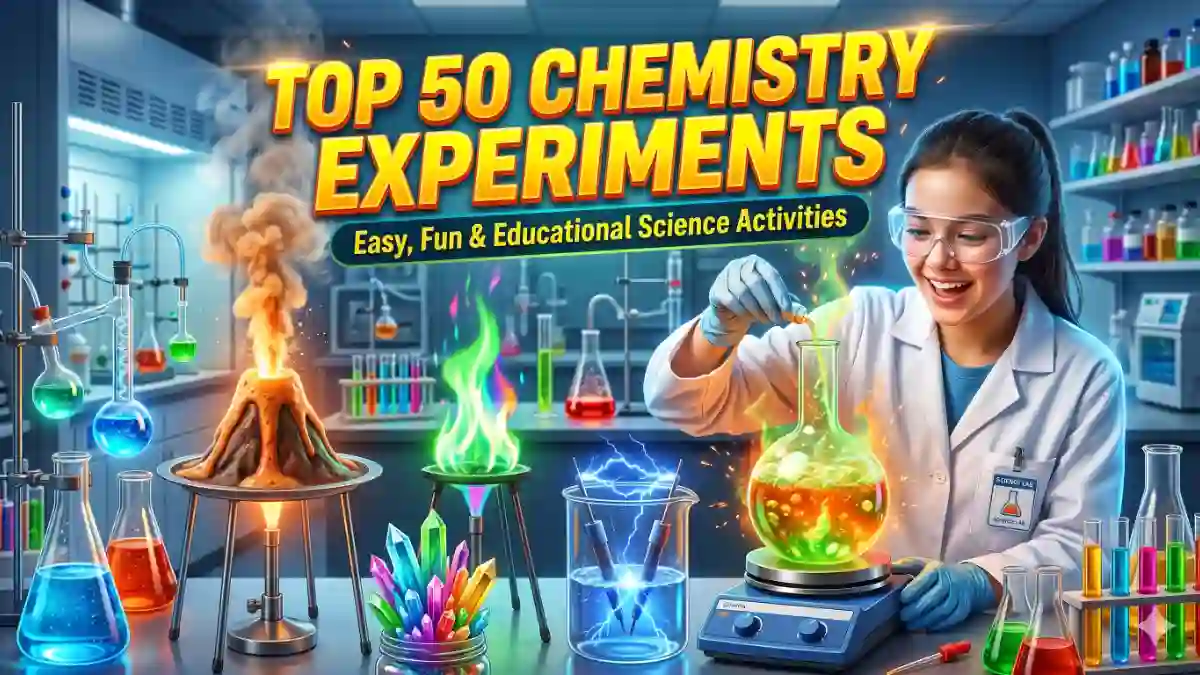

Chemistry experiments are one of the best ways to learn science in a practical and interesting way. They help students understand chemical reactions, acids, bases, gases, crystals, colors, and many other scientific concepts. From school laboratories to home science projects, chemistry experiments make learning fun, interactive, and memorable.
Table of Contents
In this article, we will explore the Top 50 chemistry experiments that are popular among school students, college learners, teachers, and science enthusiasts. These chemistry experiments are simple, educational, and useful for improving scientific knowledge.
What Are Chemistry Experiments?
Chemistry experiments are practical activities performed to study chemical reactions and scientific principles. They involve mixing chemicals, observing reactions, measuring changes, and understanding how matter behaves.
Chemistry experiments are widely used in:
- School science labs
- College practical classes
- Science exhibitions
- Research laboratories
- Home learning projects
These experiments improve observation skills, analytical thinking, and scientific understanding.
Importance of Chemistry Experiments
Chemistry experiments are important because they:
- Make science easy to understand
- Improve practical knowledge
- Help students learn faster
- Increase interest in chemistry
- Develop scientific thinking
- Teach laboratory safety and techniques
Without chemistry experiments, chemistry would remain only theoretical.
Safety Rules Before Performing Chemistry Experiments
Before starting chemistry experiments, always follow safety precautions:
- Wear safety goggles and gloves
- Work in a ventilated area
- Never taste chemicals
- Read instructions carefully
- Keep chemicals away from children
- Wash hands after experiments
- Use lab equipment properly
Safety is very important in all chemistry experiments.
Top 50 Chemistry Experiments
1. Volcano Eruption Experiment
This is one of the most famous chemistry experiments. Baking soda reacts with vinegar to produce carbon dioxide gas, creating a volcano effect.
Materials
- Baking soda
- Vinegar
- Dish soap
- Food color
Concept
Acid-base reaction.
2. Invisible Ink Experiment
Write messages using lemon juice and reveal them using heat.
Concept
Oxidation reaction.
3. Crystal Growing Experiment
Grow beautiful crystals using salt or sugar solutions.
Concept
Crystallization.
4. Elephant Toothpaste Experiment
A foamy reaction created using hydrogen peroxide and yeast.
Concept
Decomposition reaction.
5. Density Rainbow Experiment
Create colorful liquid layers using liquids of different densities.
Concept
Density differences.
6. Red Cabbage Indicator Experiment
Use cabbage juice to identify acids and bases.
Concept
Natural pH indicator.
7. Milk and Food Coloring Experiment
Soap reacts with fats in milk, creating colorful movement.
Concept
Surface tension.
8. Homemade Slime Experiment
Prepare slime using glue and borax solution.
Concept
Polymer chemistry.
9. Floating Egg Experiment
Salt water increases density and makes eggs float.
Concept
Density and buoyancy.
10. Rusting Iron Experiment
Observe how iron reacts with oxygen and moisture.
Concept
Oxidation.
11. Water Electrolysis Experiment
Split water into hydrogen and oxygen gases using electricity.
Concept
Electrolysis.
12. Fireproof Balloon Experiment
A water-filled balloon resists heat better than an air-filled balloon.
Concept
Heat absorption.
13. Homemade pH Paper Experiment
Create pH strips using natural indicators.
Concept
Acid-base chemistry.
14. Sugar Snake Experiment
Heat sugar and baking soda to create a black snake-like structure.
Concept
Combustion reaction.
15. Color Changing Water Experiment
Use chemicals to change water color magically.
Concept
Chemical indicators.
16. Dry Ice Fog Experiment
Dry ice creates thick fog when placed in warm water.
Concept
Sublimation.
17. Glue and Borax Polymer Experiment
Learn about polymers and cross-linking.
Concept
Polymerization.
18. Homemade Lava Lamp Experiment
Create moving bubbles using oil and water.
Concept
Density and gas formation.
19. Copper Sulfate Crystal Experiment
Grow blue copper sulfate crystals.
Concept
Crystal formation.
20. Candle in Water Experiment
A candle consumes oxygen and raises water level.
Concept
Air pressure and combustion.
21. Soap Bubble Experiment
Create giant soap bubbles.
Concept
Surface tension.
22. Acid Rain Experiment
Simulate acid rain effects on materials.
Concept
Environmental chemistry.
23. Magic Milk Experiment
Food colors move rapidly due to soap interaction.
Concept
Molecular movement.
24. Baking Soda Rocket Experiment
Gas pressure launches a small rocket.
Concept
Gas expansion.
25. Thermite Reaction Experiment
A high-temperature reaction involving aluminum and iron oxide.
Concept
Redox reaction.
26. Hydrogen Gas Experiment
Produce hydrogen gas using metals and acids.
Concept
Chemical reactions producing gas.
27. Oxygen Gas Preparation Experiment
Prepare oxygen using hydrogen peroxide decomposition.
Concept
Catalytic decomposition.
28. Carbon Dioxide Fire Extinguisher Experiment
Carbon dioxide can extinguish flames.
Concept
Gas properties.
29. Ink Chromatography Experiment
Separate colors from ink using paper chromatography.
Concept
Chromatography.
30. Hard Water Experiment
Test water hardness using soap.
Concept
Mineral chemistry.
31. Flame Test Experiment
Different metals produce different flame colors.
Concept
Atomic emission.
32. Magnetic Ferrofluid Experiment
Observe magnetic liquid behavior.
Concept
Magnetism and nanotechnology.
33. Soap Making Experiment
Prepare soap using fats and sodium hydroxide.
Concept
Saponification.
34. Ester Formation Experiment
Create fruity-smelling esters.
Concept
Organic chemistry.
35. Battery from Lemon Experiment
Generate electricity using lemons.
Concept
Electrochemistry.
36. Copper Plating Experiment
Deposit copper onto another metal surface.
Concept
Electroplating.
37. Thermochromic Color Change Experiment
Observe temperature-based color changes.
Concept
Thermochemistry.
38. Silver Mirror Experiment
Create a silver coating inside glass.
Concept
Reduction reaction.
39. Water Filtration Experiment
Purify water using sand and charcoal.
Concept
Filtration.
40. Chemical Garden Experiment
Grow colorful chemical structures in water glass.
Concept
Precipitation reactions.
41. Ice Cream in a Bag Experiment
Prepare ice cream using freezing point depression.
Concept
Thermodynamics.
42. Glowing Water Experiment
Create glowing solutions using fluorescent substances.
Concept
Luminescence.
43. Exploding Foam Experiment
Rapid decomposition creates expanding foam.
Concept
Gas evolution.
44. Hydrogen Balloon Experiment
Fill balloons with hydrogen gas.
Concept
Gas properties.
45. Acid and Metal Reaction Experiment
Observe metal reactions with acids.
Concept
Single displacement reaction.
46. Water Density Tower Experiment
Arrange liquids according to density.
Concept
Liquid density.
47. Bleaching Experiment
Study how bleach removes color.
Concept
Oxidation chemistry.
48. Nail Polish Chemistry Experiment
Understand evaporation and polymers.
Concept
Organic compounds.
49. Plastic from Milk Experiment
Make biodegradable plastic using milk and vinegar.
Concept
Protein chemistry.
50. Photosynthesis Experiment
Observe oxygen production in plants.
Concept
Biochemistry.
Best Chemistry Experiments for School Students
Some of the easiest and safest chemistry experiments for students are:
- Volcano experiment
- Slime experiment
- Density rainbow
- Floating egg
- Crystal growing
- Lemon battery
- Lava lamp experiment
These chemistry experiments are simple and educational.
Chemistry Experiments for Science Exhibitions
For science fairs and exhibitions, students can perform:
- Elephant toothpaste
- Chemical garden
- Silver mirror experiment
- Water electrolysis
- Dry ice fog experiment
- Soap making experiment
These chemistry experiments attract attention and demonstrate scientific concepts clearly.
Benefits of Performing Chemistry Experiments
Chemistry experiments help students:
- Understand reactions practically
- Improve memory and learning
- Build scientific curiosity
- Learn laboratory skills
- Develop problem-solving abilities
Practical learning through chemistry experiments is more effective than theory alone.
Conclusion
Chemistry experiments are exciting, educational, and useful for students of all ages. They help explain scientific concepts in a practical way and make learning more enjoyable. From simple home projects to advanced laboratory activities, chemistry experiments improve creativity, observation skills, and scientific understanding.
If you are interested in science, start with easy chemistry experiments and gradually explore advanced reactions and concepts. Always follow safety precautions while performing chemistry experiments.
Whether you are a school student, teacher, college learner, or science enthusiast, these top 50 chemistry experiments will help you discover the fascinating world of chemistry.